Brown Leaf Tips: Causes and Simple Fixes
Why do my plant's leaf tips turn brown?
On this page
First, What Brown Leaf Tips Are Actually Telling You
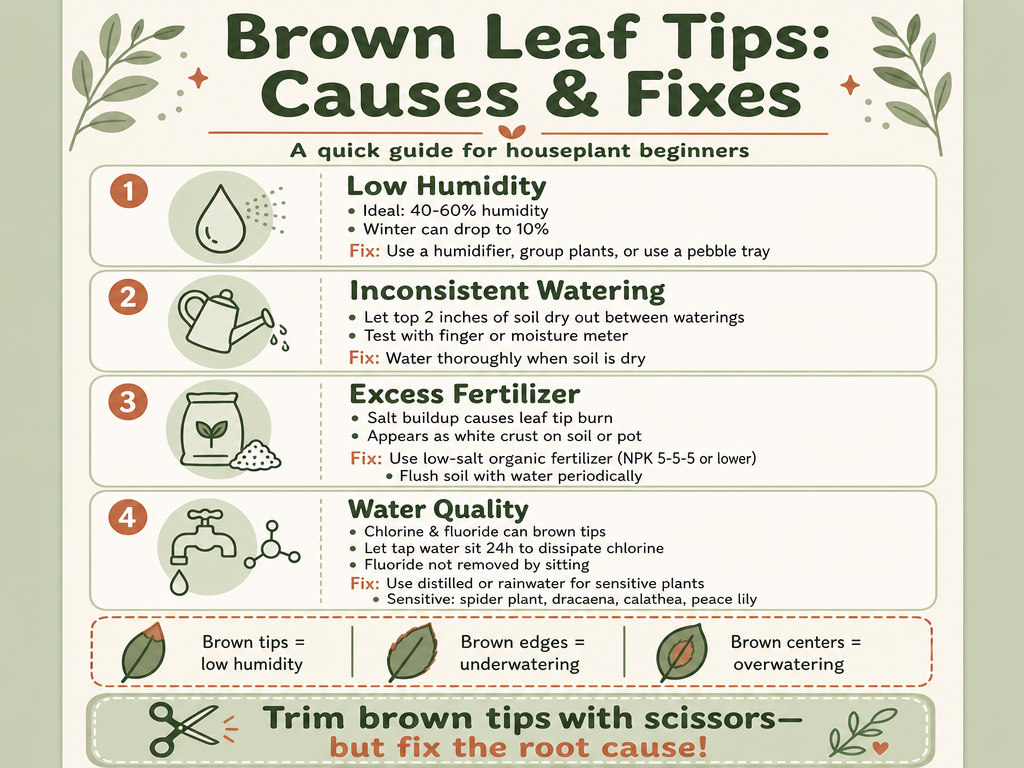
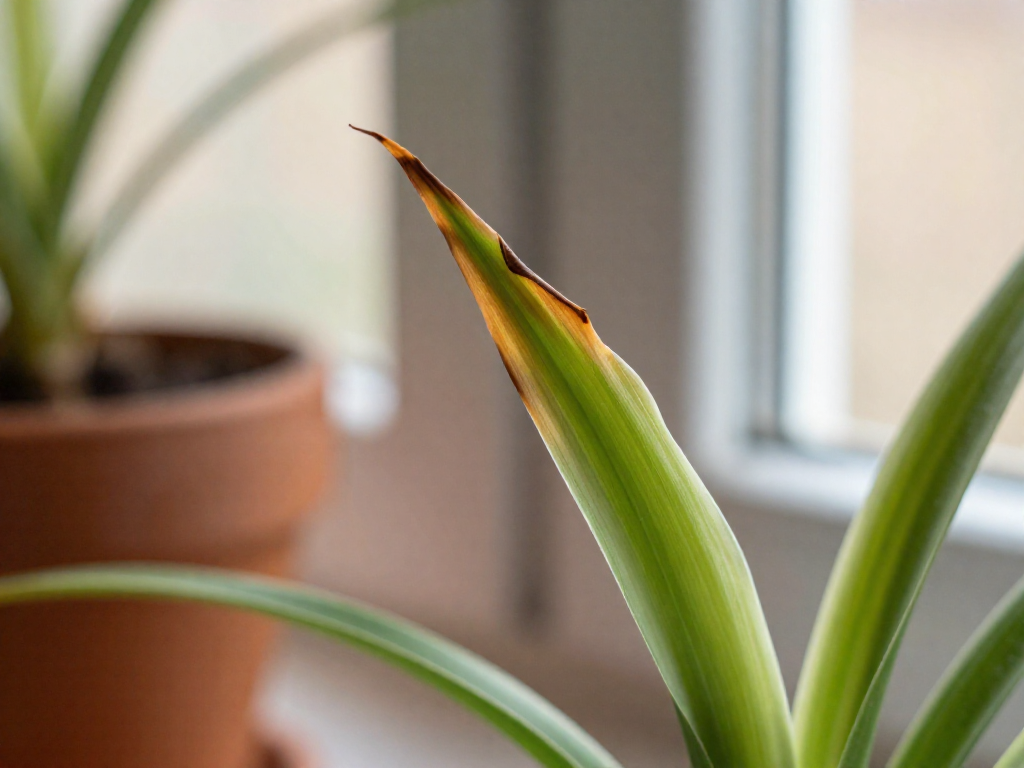
Your plant's leaf tips turn brown because something is disrupting how water reaches them. Water travels from the roots up through the stems and reaches the tips last. When supply is interrupted, the tips lose out and die from a kind of drought. So brown tips aren't a random blemish—they're a signal worth reading.
Here's the honest part: brown tips are dead tips. You can't revive dead leaf cells, but you can correct the underlying cause and save the rest of the plant. And in most cases that cause is everyday care, not pests or disease.
The trick is to read the pattern instead of just trimming the damage:
- Only the tips are brown → usually low humidity (the most common culprit, especially in winter when apartment air is dry).
- Browning along the leaf edges → usually underwatering.
- Browning in the middle or general yellow-brown → often overwatering or salt buildup from too much fertilizer.
Some plants are simply more prone to showing it. Watch for brown tips on spider plants, dracaena, prayer plants, calathea, peace lily, palms, and Boston fern—all common apartment picks with sensitive foliage.
One caution before you reach for scissors: trimming the brown parts improves appearance, but new browning will keep returning until you fix the root cause. The sections below walk through each cause and its simple fix.
Cause #1: Low Humidity (Especially in Winter)
If your leaf tips keep turning brown, dry air is the most likely culprit. Iowa State Extension names low humidity as the top cause, and notes that home humidity is often low—especially during winter, when heating systems strip moisture from the air. Piedmont Master Gardeners adds a helpful clue: brown tips usually point to low humidity, while browning along the whole edge usually points to underwatering.
Relative humidity (the amount of moisture in the air compared to the most it could hold) is the number to watch. Most houseplants are happiest between 40–60%. ASHRAE, the engineering body that sets indoor-air standards, recommends keeping homes between 30% and 60%. The problem: in winter, indoor air can fall to 10–30%—well below what tropical houseplants evolved for.
Why apartments are especially dry
Small spaces concentrate the usual offenders. Forced-air heat, radiators, and the dry gusts near heating or AC vents all pull moisture out fast. If a plant sits right beside a vent or heater, it's getting hit hardest.
What actually works
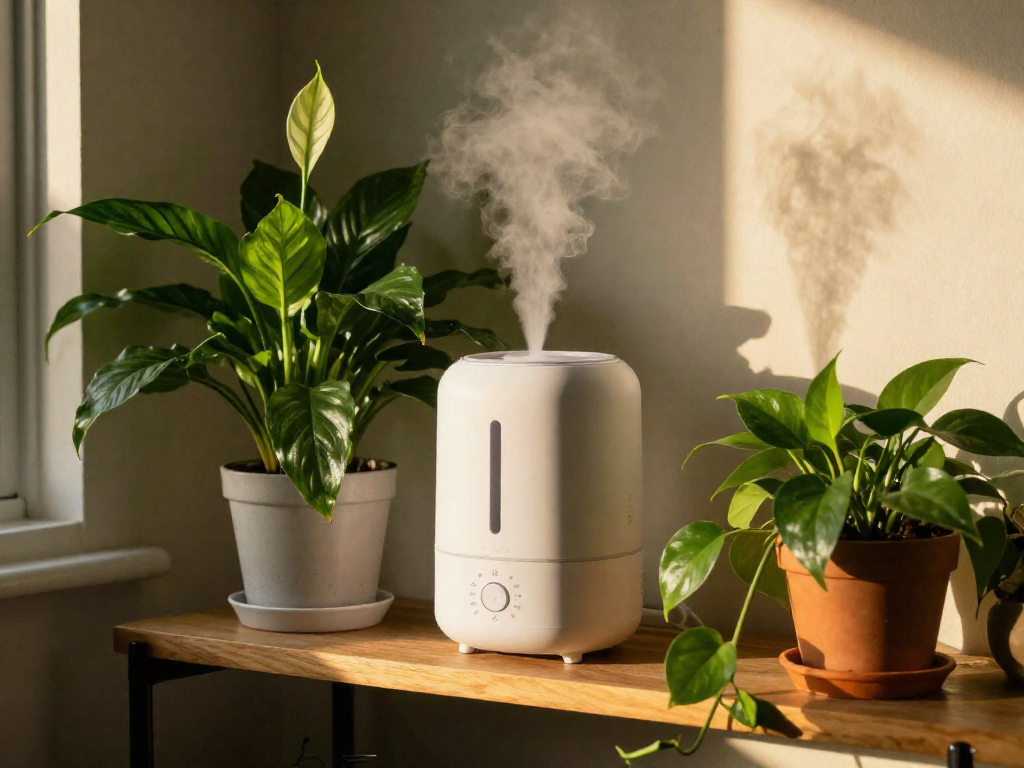
- Run a humidifier near your plants—this is the most reliable fix.
- Group plants together so they share the moisture they release.
- Grow humidity-lovers under glass or in a terrarium (an enclosed glass container).
What barely works
Misting is the popular advice, but Penn State Extension is blunt: after misting, the humidity boost "only lasts until the water evaporates"—often a matter of minutes—"so even daily misting does nothing to raise the humidity levels around a plant." The same source questions wet-pebble trays, too.
Quick action steps: Move plants away from vents and radiators. Cluster them on a tray or shelf. Add a small humidifier nearby and aim for 40–60%. A cheap hygrometer takes the guesswork out.
Cause #2: Inconsistent Watering
Watering is the most common reason houseplants get brown tips—and it's usually not about giving too little or too much on any single day. It's about swinging back and forth. When a plant dries out too long between waterings, its leaf edges and tips are the first to go brown, because they're the last part to receive water as it travels up from the roots (Iowa State Extension).
Here's the tricky part: both under- and over-watering can cause browning, but they often look different. Letting the soil get bone-dry tends to brown the tips and edges, while consistent over-watering often shows up as browning in the middle of the leaf. If you're not sure which is happening, check the roots—healthy roots are firm and light-colored, while mushy, dark, or foul-smelling roots point to over-watering (RHS).
How to Check Before You Water
Don't water on a fixed calendar schedule. Instead, check the soil each time:
- Finger test: Push a finger about two inches into the soil. If it feels dry at that depth, it's time to water. If it's still damp, wait (Piedmont Master Gardeners).
- Pot weight: Lift the pot. A dry pot feels noticeably lighter than a freshly watered one—after a few weeks you'll know the difference by feel.
- Moisture meter: An inexpensive probe gives a quick reading if you'd rather not touch the soil.
The goal is consistency: water thoroughly when the top couple of inches dry out, then let it reach that point again before the next round. Steady habits, not a rigid schedule, keep those tips green.
Cause #3: Water Quality (Chlorine, Fluoride, Softened Water)
If your watering routine is solid but the tips still brown, look at what's coming out of your tap. This cause is easy to overlook, but it matters for a specific group of plants.
Which plants are sensitive? Spider plants, dracaenas, palms, bamboo, Boston ferns, peace lilies, prayer plants, and calatheas are the usual suspects. These often have long, strappy leaves. As the plant transpires (moves water up from roots and releases it through the leaves), excess minerals ride along and get "stuck" at the very tip, where they build up and burn the tissue.
Chlorine vs. fluoride vs. sodium. Chlorine doesn't harm most plants, though it can slowly brown tips over time. The bigger offenders are fluoride and sodium, which accumulate in leaf tissue and don't wash out.
Clearing up the "24-hour water" myth. You may have read that letting tap water sit out overnight makes it safe. That's only half true: sitting does dissipate chlorine, but it does not remove fluoride or sodium. So it won't fix tip burn on fluoride-sensitive plants.
Better water for sensitive plants:
- Distilled water
- Reverse osmosis water
- Rainwater
- Water collected from your dehumidifier (it's free of both chlorine and fluoride)
Avoid softened water. Water softeners work by adding sodium, so softened water is high in salt—exactly what damages these plants.
One caveat: already-browned leaf tips won't turn green again. Switch your water source to prevent new browning, then trim the dead tips for looks if you like.
Cause #4: Too Much Fertilizer (Salt Buildup)
Fertilizers are salts. When you feed a plant too often or too heavily, those salts collect in the soil faster than the plant can use them—and the result is what growers call fertilizer burn (also known as tip burn). The extra salt actually draws moisture away from the roots, creating a kind of artificial drought even when the soil is damp. Left unchecked, high salt levels can become toxic to roots and eventually kill the plant.
How to spot it
- A white or grey crystallized coating on the leaves.
- A white crust on the soil surface or around the rim of the pot.
If you see either sign, salt buildup is the likely culprit.
How to fix it
- Flush the soil. Water thoroughly until it runs freely out the drainage holes, several times, to rinse the excess salts out.
- Water with low-salt water. Use filtered or rain water going forward.
- Follow the label. Feed only as often and at the strength the fertilizer directions specify—never more.
A beginner-safe feeding approach
Reach for a low-salt organic fertilizer with a low NPK ratio (the three numbers on the label showing nitrogen, phosphorus, and potassium), such as 5-5-5 or lower. Gentle formulas are much harder to overdo.
When in doubt, under-fertilize rather than over-fertilize. A slightly hungry plant is easy to fix; a salt-burned one takes weeks to recover.
Should You Trim Brown Tips? (And How)
Yes, you can trim brown tips to tidy up a plant—but set your expectations first. Brown tips are dead tissue, and dead leaf cells won't turn green again. Trimming improves appearance, but new browning will keep returning if you don't fix the underlying cause (humidity, watering, water quality, or fertilizer buildup from earlier sections).
So the order matters: fix the cause first, then groom for looks.
How to trim brown tips:
- Use clean, sharp scissors (wipe the blades with rubbing alcohol to avoid spreading disease).
- Follow the natural shape of the leaf—cut at an angle or point so the trimmed edge mimics the leaf's original tip.
- Leave a thin sliver of the brown edge rather than cutting into healthy green tissue, which can trigger fresh browning.
Once you've corrected the root cause, only new growth will come in clean and green. The trimmed leaves just keep the plant looking neat in the meantime.
A Simple Diagnosis Checklist
Not sure which cause is yours? Match what you're seeing to the row below, then apply the one-line fix. Work top to bottom—the first match that fits your plant is usually your answer.
| What you see | Likely cause | Quick fix |
|---|---|---|
| Only the tips are brown + dry winter air | Low humidity | Add a humidifier or pebble tray, or group plants together. |
| Leaf edges browning + soil is often bone-dry | Inconsistent watering | Water on a schedule—when the top inch of soil is dry, not weeks later. |
| Sensitive species (spider plant, dracaena, calathea, prayer plant) + tap water | Water quality (chlorine/fluoride) | Switch to filtered, distilled, or rainwater. |
| White crust on the soil surface or pot rim | Fertilizer salt buildup | Flush the pot with water and ease off feeding; use a low-salt fertilizer. |
| Browning in the middle of leaves, not the tips | Likely overwatering | Let the soil dry out more and check that the pot drains freely. |
Still stuck? Low humidity and uneven watering are the two most common culprits, so start there. Fix the root cause first—trimming brown tips only helps the look, and new browning returns if the underlying problem stays.
Sources
- Why does my houseplant have brown leaf tips and edges? | Yard and Garden — yardandgarden.extension.iastate.edu
- Houseplants With Brown Leaf Tips – Piedmont Master Gardeners — piedmontmastergardeners.org
- How to Save Brown-Tipped Plants — pennington.com
- How to Get Rid of Brown Leaf Tips on My Houseplants - Healthy Houseplants — healthyhouseplants.com
- Will Chlorine and Fluoride Hurt my Houseplants? - Healthy Houseplants — healthyhouseplants.com
- How to Water Indoor Plants — missouribotanicalgarden.org
- Leaf damage on houseplants — rhs.org.uk
- Humidity and Houseplants — extension.psu.edu
- Best Water For Plants: The Complete Guide | Aquasana — aquasana.com
FAQ
Why do my plant's leaf tips keep turning brown even after I trim them?
Trimming removes the dead brown tissue and improves appearance, but it doesn't fix what's causing the browning—so new brown tips keep appearing. Brown tips are dead leaf cells that can't be revived, and they signal an underlying care problem. The most common culprits are low humidity, inconsistent watering (especially letting the soil dry out too long), and salt buildup from over-fertilizing. Identify and correct the root cause: check whether your indoor humidity is low, water on a consistent schedule when the top 1-2 inches of soil are dry, and ease back on fertilizer. Once the cause is fixed, freshly trimmed leaves and new growth will stay green.
Will brown leaf tips turn green again?
No. Brown tips are dead leaf cells, and dead tissue cannot turn green or recover. Fixing the underlying cause—humidity, watering, or fertilizer salts—won't heal the browned areas, but it will keep new growth healthy. If the brown tips bother you, trim them off with clean scissors, following the leaf's natural shape, and focus on correcting your care so future leaves stay green.
Does letting tap water sit out overnight fix brown tips?
Only partly. Letting tap water sit out for about 24 hours allows chlorine to dissipate, which can help chlorine-sensitive plants. However, it does not remove fluoride or sodium—two other minerals that cause brown tips on sensitive species like spider plants and dracaenas over time. If you suspect your water is the problem, switch to a low-mineral source such as distilled, reverse-osmosis, or rainwater instead. Avoid softened water entirely, since it is high in salt.
What humidity level do houseplants need?
A relative humidity (the amount of moisture in the air compared to the maximum it can hold) of about 40 to 60 percent is ideal for most houseplants. The problem is that heated indoor air in winter can drop well below 30 percent—sometimes as low as 10 percent—which is a leading cause of brown leaf tips. To raise humidity effectively, group plants together, grow them under glass (like a terrarium), or run a room humidifier near your plants.
Does misting really help brown leaf tips?
Not meaningfully. Misting raises the humidity around a plant only until the water evaporates, which can take just a few minutes—so even daily misting does little to sustain the humidity levels that prevent brown tips. If low humidity is causing your brown tips, use more lasting solutions: run a humidifier, group plants together to pool their moisture, or grow humidity-loving plants under glass in a terrarium.
Which houseplants are most prone to brown leaf tips?
Plants with long, strappy leaves are the most prone, because water has the farthest to travel and minerals tend to accumulate at the leaf tips. The most commonly affected species include spider plants, dracaenas, ti plants, prayer plants, and calatheas, along with palms, bamboo, Boston ferns, and peace lilies. These plants are especially sensitive to fluoride and other minerals in tap water and to low humidity. If you grow any of them, use low-mineral water (distilled, reverse-osmosis, or rainwater), water consistently, and keep humidity in the 40-60 percent range.
See also
- How to water indoor plants correctly
- Best low-maintenance houseplants for apartments
- How to increase humidity for houseplants in a small space
- Beginner's guide to fertilizing houseplants
- Spider plant care guide
- Dracaena care guide
Related articles
My New Plant Is Dropping Leaves: Is It Normal?
New plant dropping leaves after you brought it home? Learn when leaf drop is normal acclimation and when it signals a real problem you need to fix.
Jul 14, 2026 · 5 min read
Leggy, Stretched-Out Plants: Why and How to Fix It
Is your plant growing tall, pale, and sparse? Learn what causes leggy, etiolated growth and the exact steps to fix it and prevent it from coming back.
Jul 14, 2026 · 10 min read
Overwatering vs. Underwatering: How to Tell the Difference
Is your plant overwatered or underwatered? Compare symptoms side by side, run 4 quick checks, and follow plant-by-plant recovery steps for apartment plants.
Jul 14, 2026 · 8 min read