Leggy, Stretched-Out Plants: Why and How to Fix It
Why is my plant growing tall and sparse?
On this page
What "Leggy" Actually Means (and Why It's Called Etiolation)

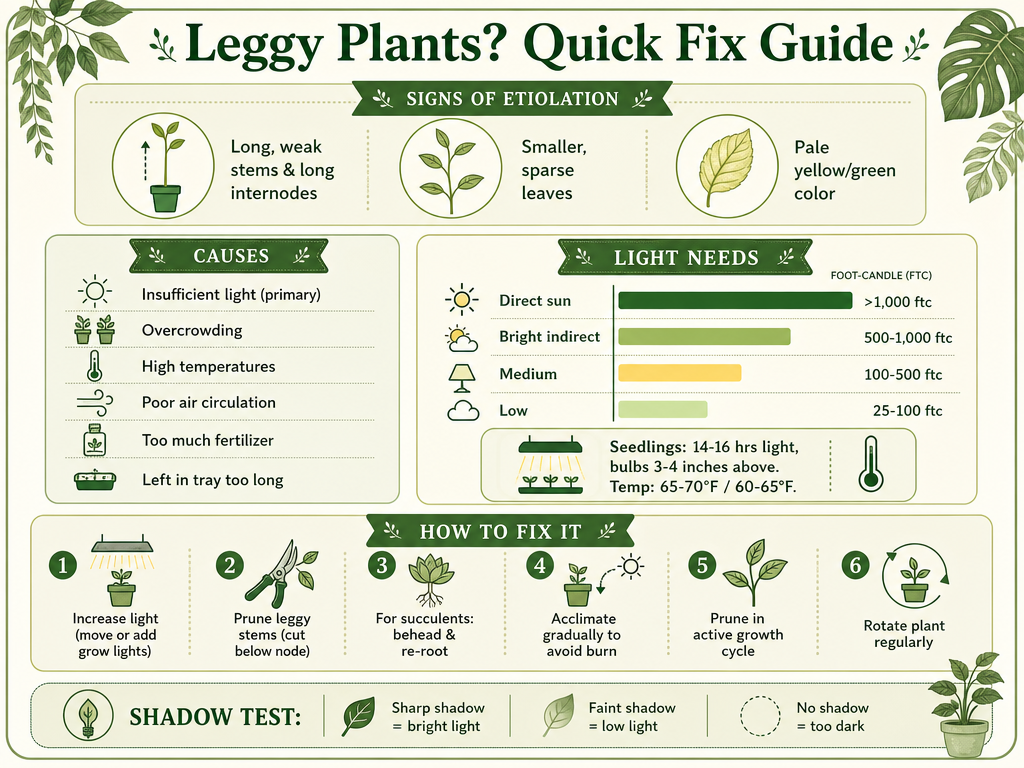
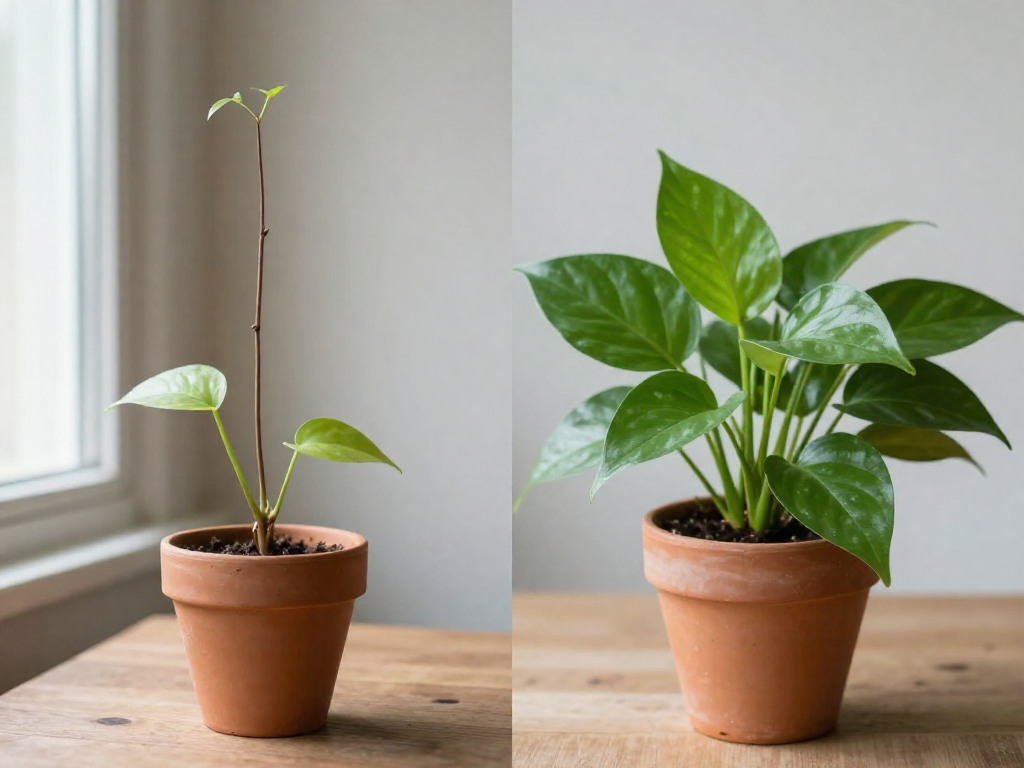
If your plant is growing tall and sparse, you're almost certainly looking at etiolation — the botanical name for the pale, stretched-out growth plants produce when they aren't getting enough light. The Oxford English Dictionary defines an etiolated plant simply as one that's "pale and drawn out due to a lack of light," and insufficient light is the primary cause. "Leggy" is just the everyday word plant parents use for the same thing.
Here's how to confirm it's what you're seeing. An etiolated plant usually shows several of these signs at once:
- Long, weak stems that flop or bend easily
- Big gaps between the leaves (the space between leaf joints is called an internode — long internodes are the classic giveaway)
- Smaller leaves than the plant normally grows
- Faded, yellowish color instead of rich green, because the plant can't make enough chlorophyll in low light
- Leaning toward the nearest window, with lower leaves sometimes yellowing and dropping
If that sounds like your plant, take a breath: this is one of the most common problems new plant parents run into, especially in apartments with limited windows and during winter when daylight is short. It's very fixable, and the rest of this guide walks you through exactly how.
Why Your Plant Is Stretching: The Real Cause
Almost every time, the answer is simple: your plant isn't getting enough light. Plants naturally grow toward the brightest source they can find—a behavior called phototropism (photo = light, tropism = turning). When light is scarce, your plant pours its energy into growing taller to reach it, instead of growing fuller with leaves. The result is that long, bare stem with a tuft of foliage at the top.
Outdoors, this stretching is a smart survival trick: a seedling shaded by taller plants races upward to find the sun. Indoors, though, there's no sun to reach, so all that fast vertical growth just produces a weak, floppy plant.
Why the weak growth matters
Stretched stems are thinner and structurally weaker than compact ones, which makes them more prone to:
- Rot and disease
- Pests
- Sunburn if suddenly moved to bright light
- Snapping or flopping over under their own weight
That's why fixing legginess is about more than looks—it's about a healthier, sturdier plant.
When it gets worse
Low-light conditions common in apartments make stretching much more likely. Winter brings shorter, dimmer days, and north-facing windows get only a fraction of the light a south-facing one does—often too little for plants that want bright, indirect light.
Secondary factors to rule out
Light is the main driver, but a few other things can contribute to leggy, weak growth:
- Overcrowding, which shades neighboring plants
- Too much fertilizer, which forces soft, rapid growth
- High heat with poor air circulation
- Being left rootbound (roots packed tightly in the pot) too long
Check these, but start with light—it's the culprit far more often than not.
How Much Light Is Enough? (Foot-Candles Made Simple)
If you suspect low light is making your plant stretch, you can actually measure it. Light intensity is measured in foot-candles (ftc)—a foot-candle is the amount of light falling on a surface one foot away from a single candle. It's the simplest way to turn "this corner feels kind of dim" into a real number.
Here's a quick scale to work from:
- Low light: 25–100 ftc
- Medium light: 100–500 ftc
- Bright indirect light: 500–1,000 ftc
- Direct sun (indoors): 1,000+ ftc
For perspective, full unobstructed sun outdoors is around 10,000 ftc—so even your sunniest windowsill is far dimmer than the outdoors. That's why so many apartment plants end up light-starved without their owners realizing it.
No meter? Use the free shadow test. On a bright day, hold your hand a few inches above a piece of paper where the plant sits. A sharp, crisp shadow means bright light, a faint, fuzzy shadow means low light, and no shadow at all means it's too dark for most houseplants.
Window direction matters, too. North-facing windows receive only about 20% of the light a south-facing window gets, so they usually can't support plants that need bright indirect light.
Want an exact reading? Free light-meter apps for your phone can estimate foot-candles—handy for comparing spots around your apartment.
The Honest Truth: Stretched Growth Won't Un-Stretch
Here's the part nobody likes to hear: once a stem has stretched from low light (a process called etiolation), it stays stretched. Even after you move the plant to a bright spot, those long, gappy stems won't shrink back or fill in. What better light does do is change the future—all new growth will come in compact, sturdy, and healthy.
So the real fix is two things working together: more light to correct future growth, plus pruning or propagating to deal with the stretched growth you already have.
One important exception: succulents can be beheaded and re-rooted, but cacti cannot—an etiolated cactus stays that way for good. For cacti, prevention is your only tool, so get the light right from the start.
How to Fix a Leggy Plant, Step by Step
Follow these four steps in order. Remember: pruning won't un-stretch old growth, but it forces fresh, compact growth and gives you free new plants along the way.
Step 1: Give It More Light
Move the plant a few feet closer to your brightest window, ideally an unobstructed south- or west-facing one. Rotate it a quarter-turn every few days so it grows evenly instead of leaning toward the glass. If a window isn't enough (common in winter or interior apartments), add a grow light positioned close to the plant and run it about 14–16 hours a day on a plug-in timer.
Step 2: Prune During Active Growth
Cut back only when the plant is actively growing—spring and summer, during the longer days of the year. In its dormant (resting) period, it lacks the light and energy to bounce back, so cuts just sit there. Active growth means faster, bushier recovery.
Step 3: Cut Back to a Node
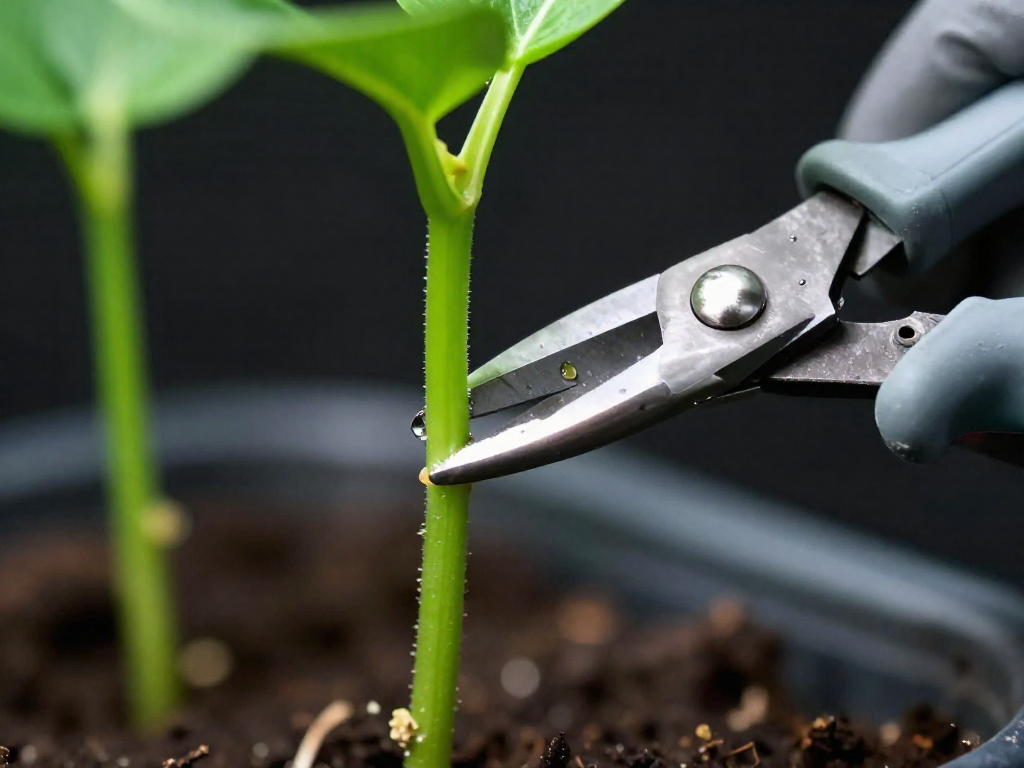
Using clean, sharp shears, shorten each long stem back to a node (the small bump where a leaf meets the stem) or to a side branch. This redirects the plant's energy into new shoots lower down, filling in the sparse, bare look. Vining plants like pothos, philodendron, and tradescantia are forgiving—you can cut them back hard to encourage dense, basal growth.
Step 4: Propagate the Cuttings
Don't toss the pieces you removed. Cut a few inches below a node with clean shears, remove the lowest leaves, and set the cutting in water or moist soil. Roots typically form over a few weeks. Pot up the rooted cuttings—or tuck them back into the parent pot—for a fuller plant.
Fixing Leggy Succulents (Beheading & Acclimating)
Succulents show etiolation (stretched, pale growth from too little light) more dramatically than most houseplants—and they're also the easiest to fix. The catch most new plant parents miss: most succulents need direct sun, not just "bright indirect" light. With few exceptions, they can't photosynthesize well in indirect light, so a spot that keeps a pothos happy will slowly stretch a succulent.
The classic fix is beheading—chopping off the top rosette and re-rooting it:
- Use clean, sharp shears and cut through the stem below the stretched section.
- Let the cutting sit out for about 24 hours so the wound calluses over (dries and seals). Planting it wet invites rot.
- Set the calloused cutting on top of dry succulent soil; it will root in a couple of weeks. The original base keeps living and usually pushes out new, compact heads.
Reintroduce sun gradually. A succulent that's been indoors will sunburn if moved straight into full afternoon light, especially in summer. Start with a couple hours of morning sun and build up over about two weeks.
One check first: if the top stays compact and colorful but the plant is tall, it's likely rootbound, not etiolated—repot instead of beheading.
How to Prevent Legginess Going Forward
Once you've fixed a stretched plant, a few steady habits keep it from happening again.
- Start with the right light. Match each plant to a spot that meets its needs before you settle it in. Sun-lovers like succulents want a bright, direct window; most foliage plants do well in bright, indirect light. Getting this right from day one prevents most legginess.
- Rotate a quarter turn weekly. Turning the pot regularly ensures even growth and keeps plants from leaning toward one side.
- Go easy on fertilizer, and give plants room. Over-feeding pushes fast, weak growth. Space plants so air moves freely between them.
- Add a grow light in winter. Natural light drops in the darker months, so plants stretch more. A simple LED grow light on for 8–12 hours makes up the difference.
- Repot when rootbound. A plant crowding its pot (roots circling or poking out the drainage holes) can stretch upward. Repot into a container an inch or two wider before it does.
Consistent light is the single biggest factor—get that right and legginess rarely returns.
Sources
- HOW TO PREVENT LEGGY (“ETIOLATED”) SEEDLINGS — joeseals.substack.com
- Why Succulent Plants Get Etiolated/ Leggy/ Stretched & How To Fix Them — youtube.com
- Succulent Growing Tall & Stretched? Identify Etiolation & Fix It! | The Succulent Eclectic — thesucculenteclectic.com
- What Is Etiolation and How Can You Prevent It? - Trex Plants — trexplants.com
- Plant Physiology — employees.csbsju.edu
- How to Fix Leggy Plants: Why Your Houseplants Look Leggy and Solutions to This Common Problem — treleaf.shop
- How I Fix Leggy Houseplants - Get Bushier Plants by Breaking This Pruning Rule — ruralsprout.com
- Renovating an Indoor House Plant — missouribotanicalgarden.org
- How Much Light Do Your Plants Need? Here’s a Detailed Houseplant Lighting Guide — thursd.com
- What Type of Lighting Do I Have, Anyway? — howmanyplants.com
FAQ
Can a leggy plant go back to normal on its own?
No. Once a stem has stretched out (a condition called etiolation, meaning growth that's pale and drawn out from too little light), that stretched growth stays stretched permanently. The plant can't shrink or 'un-stretch' the gaps between its leaves. What you can do is give it more light so new growth comes in compact and healthy, and then prune off or propagate the leggy sections. So the plant recovers, but only through new growth and pruning, not by fixing the old stems on its own.
Will my stretched stems un-stretch if I give the plant more light?
No, the already-stretched stems will not tighten back up. Etiolated growth is permanent. However, adding light is still the most important fix: once the plant gets enough light, all new growth will be compact, well-colored, and closely spaced. To handle the old leggy stems, cut them back or take cuttings and re-root them. Move the plant closer to a bright window or add a grow light so the fresh growth stays sturdy. If you're moving a plant into much stronger light, do it gradually over a couple of weeks to avoid sunburn.
How far below a node should I cut when propagating a leggy plant?
Cut a few inches below a node using clean, sharp pruning shears. A node is the small joint on a stem where leaves, buds, or roots emerge—it's where new roots will form. Leaving a couple of inches of stem below the node gives the cutting enough to anchor in water or soil while roots develop, which usually takes a few weeks. For succulents, let the cut end callus (dry over) for about 24 hours before planting so the wound heals. Prune during the plant's active growing season for the best regrowth.
Do grow lights actually fix leggy houseplants?
Yes—leggy growth is almost always caused by insufficient light, so adding a grow light directly addresses the root cause. The key is intensity and duration. Indoor light is far dimmer than sun: full outdoor sun is roughly 10,000 foot-candles (a unit of light intensity), while a low-light corner may be only 25–100 foot-candles. Position the light close to the plant and run it on a timer for a long day (seedlings often need 14–16 hours). Grow lights won't repair already-stretched stems, but they'll make all new growth come in compact and strong.
Why do my plants get leggy in winter?
Because there's simply less light in winter. Days are shorter, the sun sits lower, and overcast weather is common, so plants receive fewer hours of weaker light. In response, they stretch toward whatever light they can find (a behavior called phototropism, growing toward a light source), producing long stems, wider gaps between leaves, and sometimes dropped lower leaves. To prevent it, move plants to your brightest window, rotate them regularly for even growth, and consider a grow light to supplement the short days. Hold off on major pruning until spring, when longer days help plants regrow.
Is a leggy succulent still healthy?
A stretched succulent is usually a warning sign, not a healthy one. Etiolation in succulents comes with faded color, elongated leaves, and reduced roots, and the thin, weak growth is more prone to rot, pests, and physical breakage. Most succulents need direct sunlight and lots of it—they can't photosynthesize well in indirect light. The good news is they're fixable: 'behead' the plant by chopping off the top, let the cut callus for about 24 hours, and re-root it in bright light while the base regrows new heads. When returning any succulent to strong sun, acclimate it gradually over a couple of weeks so it doesn't burn. (Note: a succulent growing tall because it's rootbound, while staying compact and colorful, isn't etiolated.)
See also
- How much light do houseplants really need?
- Best grow lights for apartments and small spaces
- How to propagate houseplants from cuttings
- Beginner's guide to succulent care
- Best low-light houseplants for dark apartments
- How to repot a rootbound houseplant
Related articles
My New Plant Is Dropping Leaves: Is It Normal?
New plant dropping leaves after you brought it home? Learn when leaf drop is normal acclimation and when it signals a real problem you need to fix.
Jul 14, 2026 · 5 min read

Overwatering vs. Underwatering: How to Tell the Difference
Is your plant overwatered or underwatered? Compare symptoms side by side, run 4 quick checks, and follow plant-by-plant recovery steps for apartment plants.
Jul 14, 2026 · 8 min read
Why Is My Plant Drooping? Overwater, Underwater, or Shock
A drooping plant can mean thirst, overwatering, or repot shock—and they look alike. Use these simple checks to find the real cause and fix it fast.
Jul 14, 2026 · 12 min read