How to Clean Dusty Houseplant Leaves (and Why It Matters)
Should I clean my plant's leaves and how?
On this page
Does Dust Really Hurt Houseplants?
Short answer: yes, but usually not as dramatically as lab studies suggest—so clean regularly without panicking.
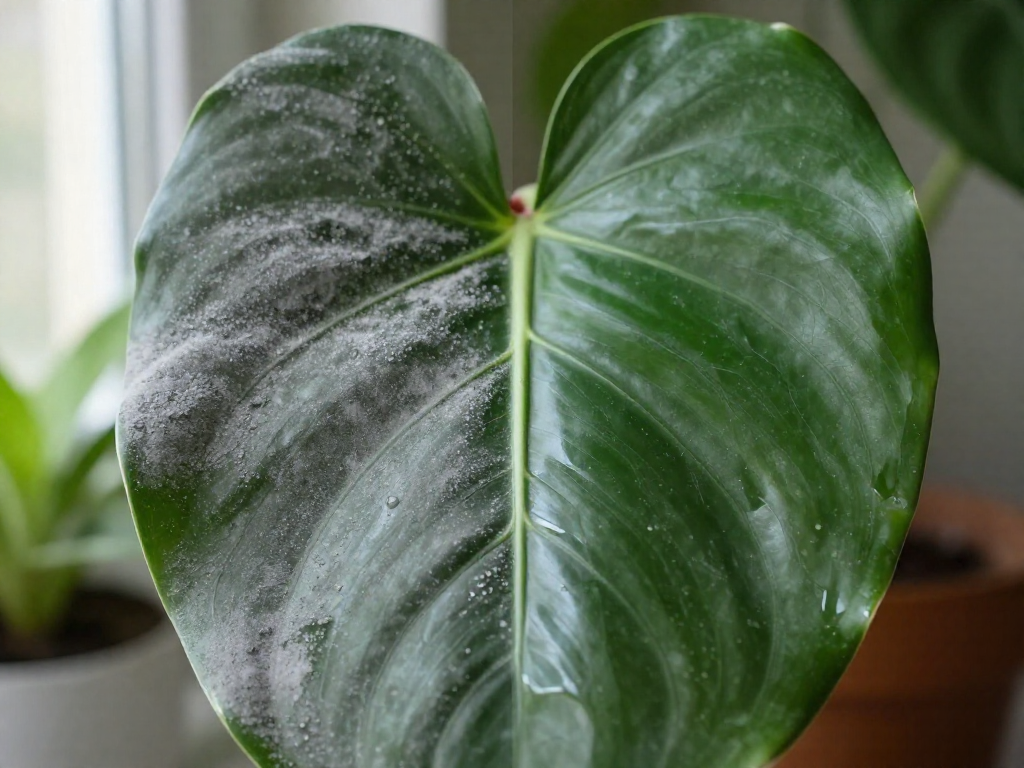
Here's why it matters. Leaves run on light. They use it for photosynthesis (the process plants use to turn light into food). A film of dust shades the leaf surface, so less light gets through. In one study on Viburnum, a heavy dust load of 10 grams per square meter cut photosynthesis by 18–30%, and measurable drops showed up with as little as 5 g/m². Dust settling on the underside of leaves is a problem too: it raised diffusion resistance by roughly 42–50%, making it harder for the plant to exchange gases and effectively "breathe." A separate cotton study found that heavy dust acts much like shade, lowering the leaf's response to light and its maximum rate of photosynthesis.
Now the reassuring part. Those are lab-heavy loads. Even outdoor roadside shrubs typically carried only about 2 g/m²—well below the amounts that hurt plants—so ordinary indoor dust rarely reaches damaging levels. Light, routine cleaning is plenty.
There's a bonus, too: wiping leaves lets you catch pests like spider mites (tiny sap-sucking bugs) early and removes the grime where disease can take hold.
How to Tell When Your Plant's Leaves Need Cleaning
Forget calendars—there's a simpler test. Glance at a leaf, then run a fingertip across it. If you can see a dull, filmy layer or feel grit on your finger, it's time to clean.
How often you'll need to do this depends entirely on how dusty your home is, not a fixed schedule. Some plants stay clean for weeks; others need attention more often.
Watch plants in higher-dust spots more closely:
- Near heating or AC vents
- Beside radiators
- Next to open windows
- Along busy walkways and doorways
When in doubt, do the finger swipe.
How to Clean Houseplant Leaves by Type
The right method depends on the leaf. Match your plant to one of these types before you reach for water.
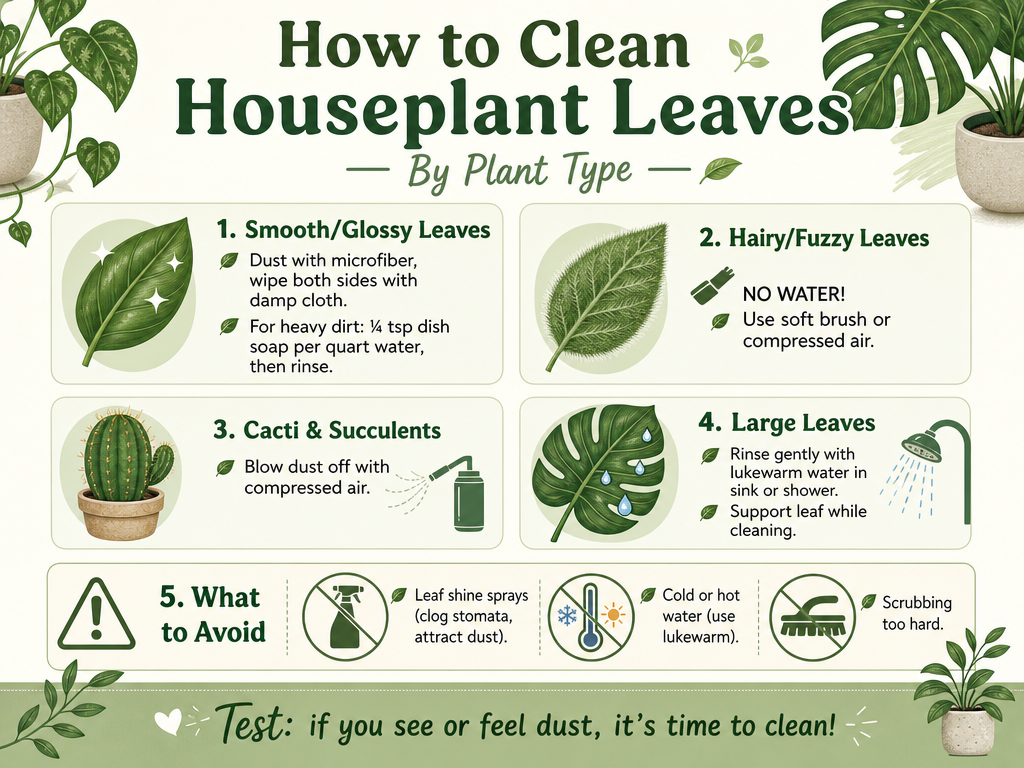
Smooth, glossy leaves (pothos, philodendron, rubber plant)
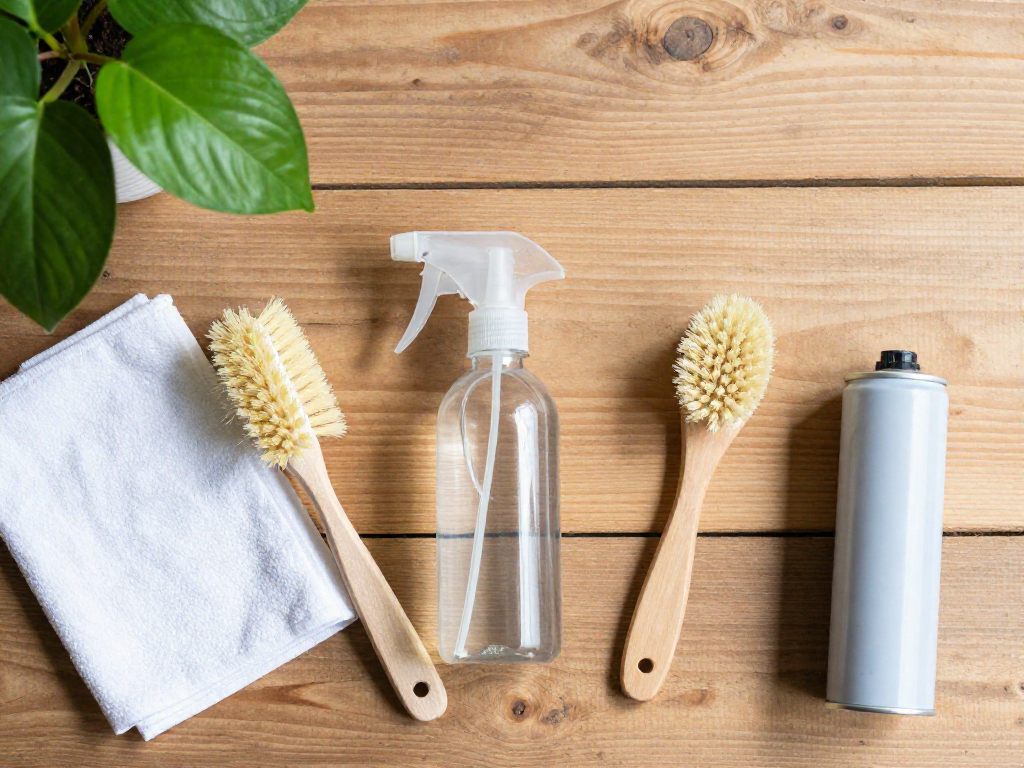
Dust first with a microfiber or electrostatic cloth to lift loose particles. Then wipe both sides of each leaf with a soft cloth dipped in lukewarm water. Always cup one hand under the leaf to support it while you wipe—this keeps you from tearing or bending it.
For heavy grime, mix about 1/4 teaspoon of dish soap into 1 quart of lukewarm water. Wipe the top and bottom of each leaf, then rinse thoroughly so no soap residue is left behind. This soap-and-water pass does double duty: it also helps remove pests like spider mites, tiny sap-sucking bugs that hide on leaf undersides.
Large-leaved plants
Rinse them in the sink or shower using a gentle, lukewarm spray about once a month or as needed. Skip cold water, which can shock the plant, and hot water, which can damage tissue. Let leaves dry before returning the plant to bright, direct sun.
Hairy or fuzzy leaves (African violet) and cacti
Do not use water—it can leave permanent spots on fuzzy leaves. Instead, whisk away dust with a soft brush or a short burst of canned compressed air. The same compressed-air trick works for cacti.
Hard-water mineral spots
Those chalky white marks come from minerals in tap water. Treat them occasionally by wiping with a mix of 1 teaspoon vinegar per gallon of water (or about 1/2 lemon squeezed per pint). The acid dissolves the deposits—but use it only as a spot treatment, not part of your routine cleaning.
Skip the Leaf Shine Sprays
It's tempting to reach for a leaf shine product to make your plants look glossy. Don't. These sprays do real harm for a purely cosmetic payoff.
Most shine products leave an oily or waxy coating that clogs the stomata—the tiny pores on leaves that plants use to breathe (taking in carbon dioxide and releasing oxygen and water vapor). Blocking them makes gas exchange harder, working against your plant's health.
That same coating also blocks light from reaching the leaf, which slows photosynthesis (how plants turn light into energy). In other words, it does the opposite of what cleaning is supposed to do.
Worse, the sticky residue acts like a dust magnet, trapping dirt and hair so the leaves get grimier and harder to clean over time.
The fix is simple: wipe leaves with a damp cloth. You'll get clean, naturally glossy leaves—no residue, no downside.
Quick Leaf-Cleaning Routine
Save this for cleaning day:
- Check — glance or swipe a finger; if you see or feel dust, it's time.
- Dust — sweep with a microfiber cloth.
- Wipe both sides with a cloth dipped in lukewarm water, supporting each leaf with your hand.
- Rinse larger leaves in the sink or shower on a gentle flow.
- Dry out of direct sun.
| Leaf type | Method | How often |
|---|---|---|
| Smooth/large | Wipe or rinse, lukewarm water | Monthly or when dusty |
| Fuzzy/hairy | Soft brush or compressed air | As needed |
| Cactus | Compressed air | As needed |
Do: use lukewarm water and support leaves. Don't: use leaf shine, cold/hot water, or water on fuzzy leaves.
Sources
- How To Clean Your Houseplants — bioadvanced.com
- The Effect of Dust on Photosynthesis and its Significance for Roadside Plants (Thompson et al. 1984) — resolutionmineeis.us
- Similar effects as shade tolerance induced by dust accumulation and size penetration of particulates on cotton leaves (PMC) — pmc.ncbi.nlm.nih.gov
- How to Clean Houseplant Leaves | The Sill — thesill.com
- Is Leaf Shine Bad for Plants? What Every Grower Should Know — epmearth.com
- The Secret to Shiny, Clean, and Healthy Indoor Houseplant Leaves | PlantVine — plantvine.com
- How To Clean Houseplant Leaves: How & Why To Do It — joyusgarden.com
FAQ
How often should I clean my houseplant's leaves?
Clean whenever you can see or feel dust—do a quick glance or finger swipe across a leaf, and if dust shows up, it's time. For most apartments that works out to roughly every 1–2 weeks for a light dusting, with a more thorough wipe-down or rinse about once a month. Homes that are dustier, drier, or near open windows may need more frequent cleaning. Keeping leaves clean matters because dust shades the leaf surface and can measurably reduce photosynthesis (the process plants use to turn light into energy).
Can I use olive oil or mayonnaise to make leaves shiny?
No. Skip olive oil, mayonnaise, and commercial "leaf shine" products. Oily coatings clog the stomata—the tiny pores plants use to breathe and exchange gases—and they block some of the light the leaf needs, which can slow photosynthesis. The oily film also acts like a magnet for dust and hair, so leaves get dirtier faster and are harder to clean. For a natural shine, just wipe both sides of each leaf with a soft cloth dipped in lukewarm water.
Is it safe to wipe leaves with dish soap?
Yes, in a mild diluted solution—don't apply it straight. For heavier grime, mix about 1/4 teaspoon of dish detergent into 1 quart (roughly 1 liter) of lukewarm water. Dip a soft cloth and gently wipe both the tops and undersides of the leaves; this also helps dislodge pests like spider mites. Always rinse the leaves afterward with clean water so no soap residue is left behind, since leftover soap can irritate the leaf surface.
Should I clean the underside of the leaves too?
Yes. Dust settles on the underside as well, where it can raise the leaf's resistance to gas exchange and hurt photosynthesis. The undersides are also where pests like spider mites tend to hide, so wiping there helps you catch and remove them early. Support each leaf with one hand and gently wipe the bottom with a soft, damp cloth using the same lukewarm water (or diluted-soap-then-rinse) method you use on top.
How do I clean fuzzy leaves like African violets?
Keep water off fuzzy or hairy leaves—moisture can leave permanent spots on plants like African violets. Instead, use a soft, dry brush (a clean paintbrush or makeup brush works well) or a short burst of canned compressed air to lift dust away without wetting the surface. The same dry approach works for cacti and other hairy-leaved plants. Only smooth-leaved plants should be wiped or rinsed with water.
Can I just mist my plants to remove dust?
Not really—misting adds a little humidity but doesn't remove dust; it usually just wets the film in place, and on hard-water areas it can leave mineral spots. To actually clear dust from smooth leaves, wipe both sides with a lukewarm-water cloth, or for larger-leaved plants rinse them in the sink or shower with a gentle, lukewarm spray about once a month. Use lukewarm (not cold or hot) water, since cold can shock the plant and hot can damage it.
See also
- Watering, Light & Soil Basics category page
- How much light does my houseplant actually need?
- How to spot and treat spider mites on houseplants
- Best low-maintenance houseplants for apartments
- Why are my plant's leaves turning brown?
Related articles
A Beginner's Glossary of Houseplant Terms
Confused by plant jargon? This plain-language glossary defines the houseplant terms beginners hit most—nodes, variegation, perlite, root-bound and more.
Jul 14, 2026 · 6 min read
Winter Houseplant Care: Watering and Light When Days Get Short
Learn how to care for houseplants in winter: cut back watering, boost light and humidity, and pause feeding so your plants survive short, dark days.
Jul 14, 2026 · 11 min read
Do Houseplants Need Humidity? What Apartments Really Require
Do your houseplants really need extra humidity? See which plants need it, what apartment air actually offers, and cheap ways to raise humidity that work.
Jul 14, 2026 · 8 min read