Tap Water vs. Filtered: What Water Is Safe for Plants?
Is my tap water hurting my plants?
On this page
The Short Answer: Tap Water Is Fine for Most Houseplants
If you're worried your tap water is slowly poisoning your plants, take a breath: for the vast majority of common houseplants, ordinary tap water at room temperature is perfectly fine. If your plants look healthy, you don't need to change a thing.
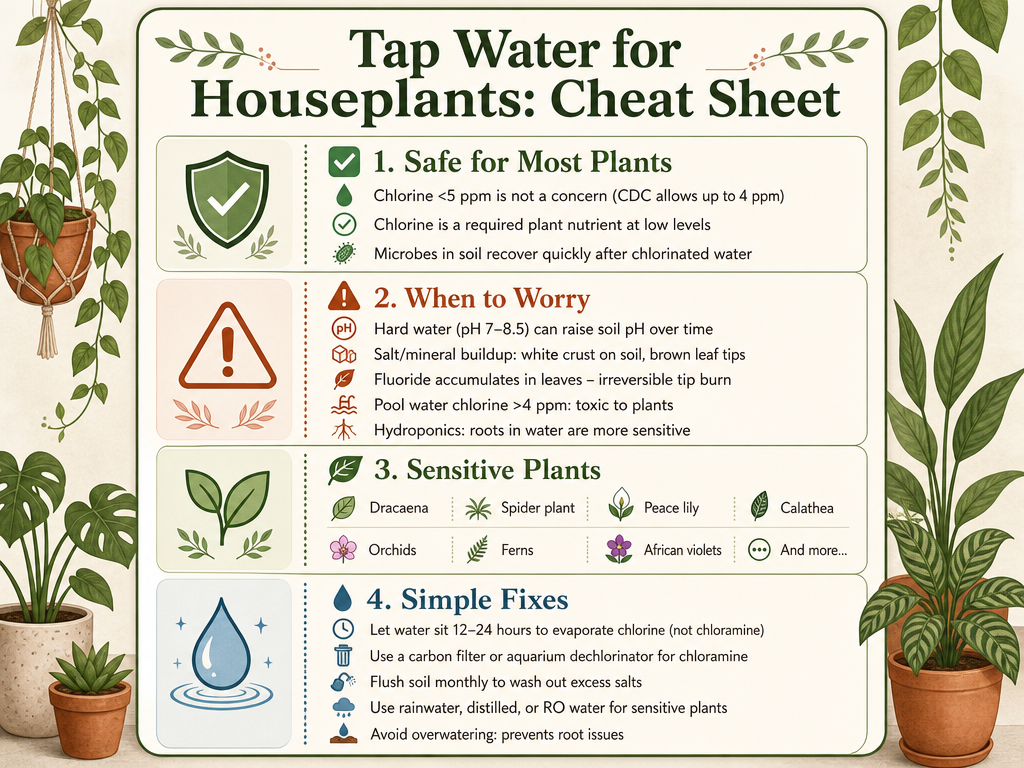
Here's why. The chlorine and chloramine (a longer-lasting chlorine-based disinfectant) that utilities add to tap water are kept at low levels for safety. The CDC considers chlorine or chloramine safe in drinking water up to 4 parts per million (ppm), and greenhouse research has found that potted ornamental plants aren't harmed by chlorine until levels reach around 150 ppm—far above what comes out of your faucet.
In fact, chlorine is a required plant nutrient in small amounts. As the old saying goes, "the dose makes the poison": a trace is helpful, and only large amounts cause damage.
So the real question isn't tap versus filtered. It's this: is your specific plant one of the few sensitive species, and are you actually seeing symptoms? A handful of plants—and setups like aquariums or hydroponics—are genuine exceptions, and we'll cover exactly which ones and what to watch for in the sections below.
What's Actually in Your Tap Water (Chlorine, Chloramine, Fluoride, Hard-Water Minerals)
Four things in tap water could matter to houseplants. Here's a simple way to think about each so you can judge your own situation.
Chlorine. The most common disinfectant. It evaporates from standing water within a few days, and once it hits soil it binds to soil particles and stays away from roots. For potted plants, it's rarely a problem.
Chloramine. A longer-lasting disinfectant used by roughly a quarter of North American municipalities. The key difference: it does not evaporate by sitting out. So the classic "leave water in a bucket overnight" trick removes chlorine but does nothing for chloramine.
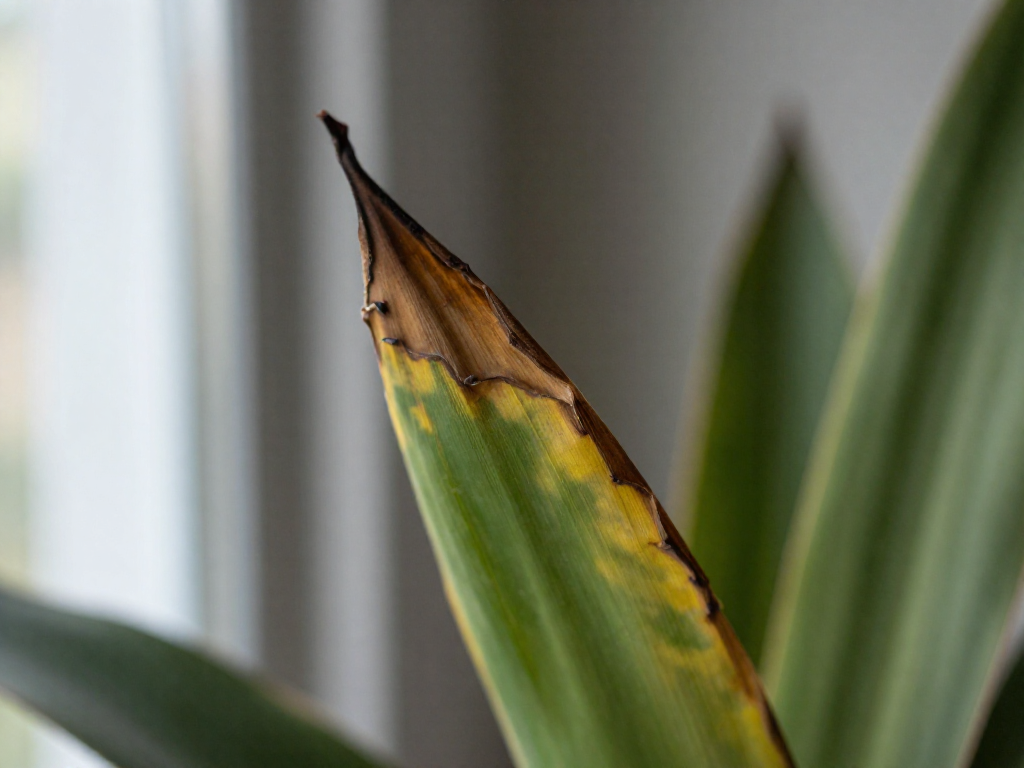
Fluoride. Added to many US water supplies at about 0.7–1 ppm to prevent tooth decay. That's too dilute to harm most plants, but fluoride accumulates in leaf tissue over time. Sensitive species (like dracaenas and spider plants) can develop brown, scorched leaf tips and margins—known as marginal necrosis, or dead tissue along the leaf edge.
Hard water. Water high in calcium and magnesium, found in over half of North American homes. It's alkaline, so with repeated watering it can gradually push your soil's pH above the slightly acidic 5.5–6.5 range most houseplants prefer, making nutrients harder to absorb.
How to find yours: Check your utility's annual water quality report or call your local water treatment center. Note that some utilities switch between chlorine and chloramine seasonally.
When Water Quality Actually Matters: Sensitive Plants and Real Symptoms
Most houseplants shrug off ordinary tap water. But a handful of popular species are genuinely sensitive to the fluoride, hard-water minerals, or chlorine in it. If you own any of these, water quality is worth a closer look:
- Dracaenas, especially the corn plant (Dracaena fragrans)
- Spider plants
- Calatheas and prayer plants
- Peace lilies
- Ferns, orchids, and African violets
These plants react when tougher ones (pothos, snake plants, ZZ plants) don't.
What the damage looks like
Fluoride burn shows up as brown, dead (necrotic—meaning the tissue has died) tips and edges on the leaves. This damage is irreversible: once a tip browns, it won't turn green again. Just trim the affected leaf back to healthy tissue with clean scissors.
Hard-water and salt buildup appears as a white, crusty film on the soil surface, followed by browning leaf tips over weeks and months as salts accumulate and block water uptake.
Brown tips aren't proof of a water problem
This is the part most people get wrong. Brown tips have many causes: overwatering, low humidity, cold drafts, and inconsistent watering all produce them too. Before you blame your tap, use this rule of thumb:
- Slow, repeating problems on a sensitive plant → likely water quality. Switch to distilled, filtered, or rainwater and watch new growth.
- Fast decline, yellowing, mushy stems, or soft roots → a watering-habit problem, not your water. Check how often and how much you're watering first.
When in doubt, fix your watering routine before you fix your water.
Simple Fixes That Actually Work (and One That Often Doesn't)
The right fix depends on what's actually bothering your plant. Here's how to match the solution to the cause.
Let water sit 12–24 hours. Filling a wide-mouth container and waiting a day lets chlorine (the disinfectant most cities add) evaporate on its own. But this trick only works for chlorine. It does nothing for chloramine (a longer-lasting chlorine-ammonia disinfectant), hard-water minerals, or fluoride. If your city uses chloramine, skip this method—call your water utility or taste the water after it sits to check.
Run it through a carbon filter. A carbon or charcoal filter removes chlorine quickly and easily—no waiting required. This is the low-effort upgrade for most tap-water worries.
For fluoride- and mineral-sensitive plants, change your water source. Rainwater, distilled water, reverse osmosis (RO) water, snowmelt, or the condensate from your dehumidifier all skip chlorine and fluoride entirely. Use these for plants showing leaf-tip burn.
Flush the pot periodically. Every few weeks, water heavily until it drains freely from the bottom. This leaches out built-up salts. Raising soil calcium and pH (for example, with dolomite lime) can also tie up fluoride so roots can't absorb it.
Match the fix to the cause. Letting water sit won't help if the real culprit was hard water or high alkalinity—you'd just be waiting on a problem that never leaves. Identify the symptom first, then pick the fix.
Real Exceptions: Pools, Ponds, and Aquariums
Everything above applies to ordinary indoor watering. A few water sources are genuinely different, so don't over-apply the "tap water is fine" verdict to them.
- Pool water: Swimming pools run far above the 4 ppm chlorine considered safe in drinking water, and that concentration can be toxic to plants. Never water with it, and keep an eye on any plants growing right next to a pool.
- Ponds and aquariums: Fish, frogs, and other aquatic life tolerate far less chlorine and chloramine than potted plants do. Unlike chlorine, chloramine doesn't evaporate from standing water, so it stays a real concern here—treat or condition water before adding it.
For your houseplants in soil, though, the verdict doesn't change: regular tap water is fine.
Sources
- Chlorine, Chloramine and Plants - Everything You Need to Know — gardenmyths.com
- Is Chlorine and Chloramine in Tap Water Harmful to Plants? — youtube.com
- About Water Disinfection with Chlorine and Chloramine — cdc.gov
- How to Make Tap Water Safe for Plants — southsideplants.com
- Best Water for Houseplants: How Tap, RO, and Distilled Water Affect Your Plants — frizzlife.com
- Dechlorinating Water for Healthier Plants — somedayilllearn.com
- Fluorine Toxicity in Plants | Pacific Northwest Pest Management Handbooks — pnwhandbooks.org
- Do you know what's wrong with my dracaena? in the Houseplants forum - Garden.org — garden.org
- Fluoride toxicity in plants irrigated with city water — canr.msu.edu
- Will Chlorine and Fluoride Hurt my Houseplants? - Healthy Houseplants — healthyhouseplants.com
See also
- How Often Should You Water Your Houseplants?
- Why Are My Plant's Leaf Tips Turning Brown?
- Best Low-Maintenance Houseplants for Apartments
- Understanding Soil pH and Potting Mix Basics
- How to Care for a Dracaena
- Peace Lily Care Guide for Beginners
Related articles
A Beginner's Glossary of Houseplant Terms
Confused by plant jargon? This plain-language glossary defines the houseplant terms beginners hit most—nodes, variegation, perlite, root-bound and more.
Jul 14, 2026 · 6 min read
How to Clean Dusty Houseplant Leaves (and Why It Matters)
Dusty leaves block light and slow plant growth. Learn the simple, safe way to clean houseplant leaves by type—plus what to avoid, like leaf shine sprays.
Jul 14, 2026 · 6 min read
Winter Houseplant Care: Watering and Light When Days Get Short
Learn how to care for houseplants in winter: cut back watering, boost light and humidity, and pause feeding so your plants survive short, dark days.
Jul 14, 2026 · 11 min read