Do Your Pots Need Drainage Holes? What Beginners Get Wrong
Are drainage holes really necessary?
On this page
The Short Answer: Yes, But It's Not the Whole Story
Yes—for most beginners, a pot with a drainage hole is the safest choice. A drainage hole simply lets excess water flow out the bottom instead of pooling in the soil. That matters because roots need air, not just water. The University of Illinois Extension puts it plainly: a hole "allows water in the soil to drain freely so adequate air is available for the roots," and "few [plants] can tolerate sitting in stagnate water."
Here's why that pooling is so dangerous. Soggy soil leaves no room for air, which invites root rot—a disease that quietly kills roots from the bottom up. And once it sets in, plants rarely recover. Drainage holes also do a second quiet job: every time water runs through and out, it flushes away salts and minerals left behind by fertilizer and tap water, keeping your soil healthier for longer.
But "no hole means a dead plant" is an oversimplification. Plenty of people grow thriving plants in hole-free pots. The real skill isn't fearing certain pots—it's understanding how much and how often to water. That's what the rest of this guide will teach you.
The Perched Water Table: Why Every Pot Stays a Little Soggy
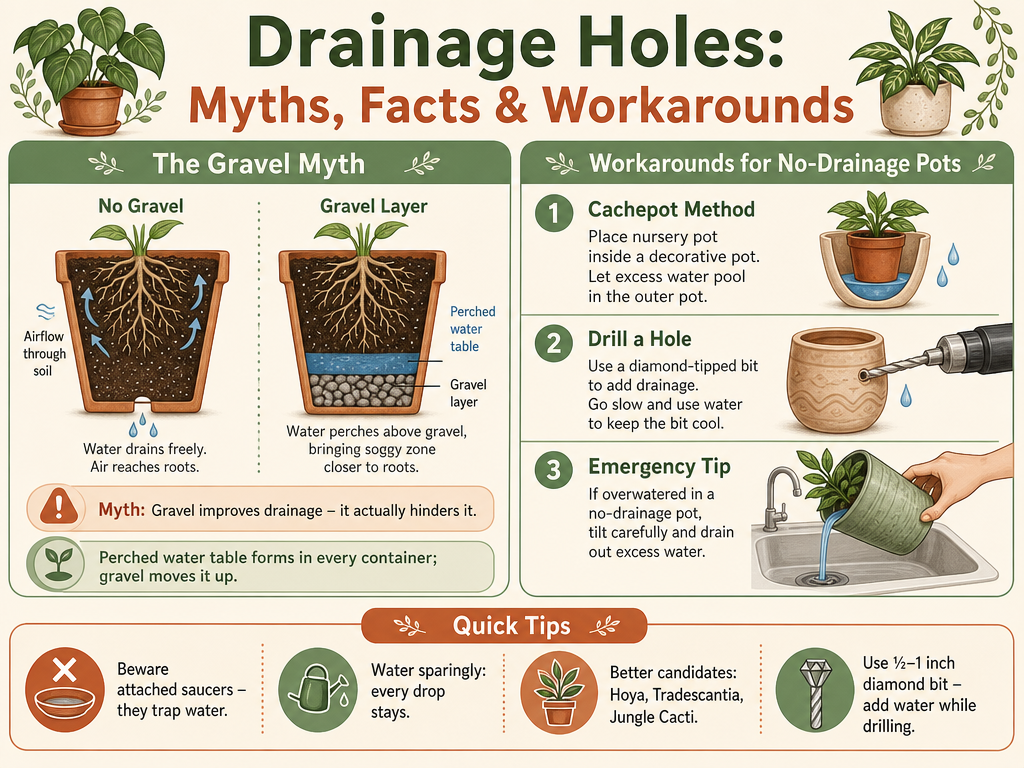
Here's the one concept that makes every drainage rule click: the perched water table. It's a saturated band of soggy soil that forms at the bottom of every container—drainage hole or not.
Why does it happen? Two forces fight over the water you pour in. Gravity pulls it down toward the bottom, while capillary action (the way water clings to soil particles and wicks upward, like a paper towel soaking up a spill) pulls it back up. They settle into a balance, leaving a permanently wet zone near the base of the pot.
Once you picture that soggy band, everything else follows:
- Taller pots help. The wet zone is roughly the same height in any pot, so in a deep pot it takes up a smaller share, leaving more airy, root-friendly soil above it.
- Shallow bowls are risky. In a short, wide, no-hole dish, that same soggy band can be most of the soil—so your roots sit in the wet zone.
That's why shallow no-hole containers are the toughest choice for beginners.
The Gravel Myth (and the New Study That Complicates It)
You've probably seen the Pinterest tip: toss a handful of gravel in the bottom of your pot for "drainage." Skip it. University horticulturists at Washington State and UC Master Gardeners call this a myth. Water doesn't drain neatly into the gravel—it perches, gathering in the soil just above the rock layer. (A perched water table is simply the saturated zone of soil that forms at the bottom of any container.)
Worse, that gravel steals space. As UC Master Gardeners put it, the saturated layer "simply moves up," reducing usable soil depth and pushing the wet zone closer to your plant's roots—exactly where you don't want it.
Now the honest caveat that keeps us credible: a 2025 PLOS One study tested 24 setups and found that thick drainage layers—like 60mm of coarse sand—often did reduce water retention. The key words are thick and coarse. A thin scattering of pebbles isn't that.
Beginner takeaway: Skip the thin gravel layer. It won't help, may hurt, and it's no substitute for an actual drainage hole.
How Many Holes You Actually Need
Good news: you don't need many. The right number depends on your pot's material and size.
- Porous pots (terracotta, clay, or wood) soak up some moisture through their walls, so one hole is usually enough.
- Non-porous pots (plastic, glazed ceramic, metal, or glass) hold every drop, so give them more room to drain: one hole for pots 6 inches or smaller, and three or more for anything larger.
And skip the coffee filter. Placing a filter or broken pot shard over the hole to "keep soil in" is unnecessary—small drainage holes let water out while losing very little soil.
Fell in Love With a No-Hole Pot? Your Real Options
Good news: a pretty pot without a hole is not a dealbreaker. You have three options, ranked from easiest to riskiest.
1. Best option: the cachepot method (staging)
A cachepot is a decorative outer pot with no drainage that hides a plain nursery pot. Keep your plant in its plastic nursery pot (the one it came in, which has holes) and simply set it inside the pretty pot. When you water, excess drains into the nursery pot's saucer. Lift the plant out, tip out any pooled water, and drop it back in. This is the safest, lowest-effort fix—professional growers pot this way whether or not the outer planter has a hole.
2. Drill your own hole
With a diamond-tipped drill bit (a ½- to 1-inch bit works for ceramic), adding a hole is genuinely easy with a low failure rate. Dribble a little water on the spot as you drill to keep the ceramic from overheating and cracking. Go slow and let the bit do the work.
3. Plant directly—carefully
Only do this if you'll water sparingly and slowly, because every drop stays inside. Two rules keep this safe:
- Don't oversize the pot. Go up no more than 1–2 inches in diameter. Extra soil with no roots to drink it stays soggy and causes accidental overwatering.
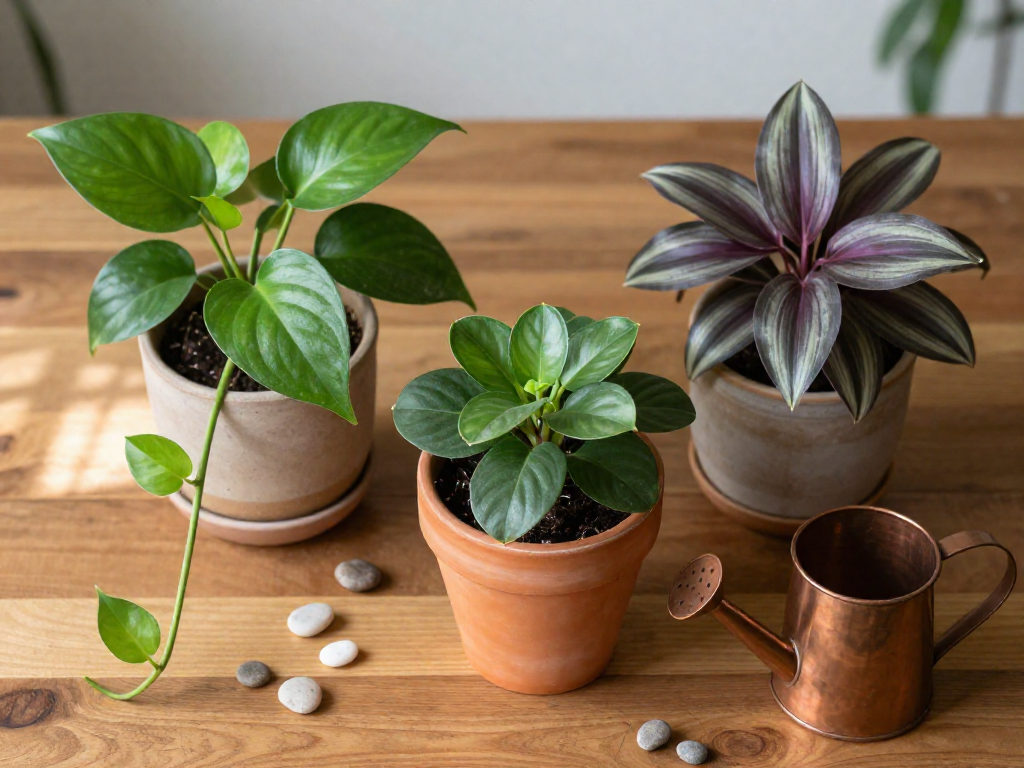
- Pick forgiving plants. Hoya, pothos (Epipremnum), tradescantia, and jungle cacti tolerate wet or crowded roots better than most.
Beginner Traps: Attached Saucers, Under-Watering, and the Sink Rescue
A few hidden mistakes trip up almost every new plant parent. Learn them now and you'll skip the heartbreak.
Watch out for permanently attached saucers. A saucer is the shallow dish that catches runoff. If it's glued to the pot, you can't pour out the overflow—so roots sit in water and rot. The Illinois Extension shares a cautionary tale: their basil leaves turned black from waterlogged roots caused by exactly this. Choose a pot with a detachable saucer, and empty it after every watering.
Don't let overwatering fear tip you into under-watering. Once beginners realize a pot can drown a plant, many respond by watering too little—which is just as deadly. Water thoroughly when the top inch of soil is dry, then let it drain.
Quick sink rescue for an already-potted no-hole plant: take it to the sink, water it, wait a few minutes, then tip the pot on its side for a minute or two to drain the excess.
One last reminder: pots without holes are a design choice, not a plant-care one. Pick one with your eyes open.
Sources
- Container Drainage Options | Container Gardens | Illinois Extension | Illinois — extension.illinois.edu
- The Importance of Drainage Holes in Plant Pots — dtystore.com
- The Myth of Drainage Material in Container Plantings — wpcdn.web.wsu.edu
- Drainage in Containers | UC Master Gardeners of Santa Clara County — ucanr.edu
- Effect of drainage layers on water retention of potting media in containers - PMC — pmc.ncbi.nlm.nih.gov
- How Do Drainage Material and Perched Water Table Affect Your Plant? | The Houseplant Guru — thehouseplantguru.com
- The myth of the myth of drainage layers in containers • Tradescantia Hub — tradescantia.uk
- Ultimate Guide - Drainage For Potted Plants | Plant Addicts — plantaddicts.com
- No Drainage Hole? Pot Plants Without Killing Them by Léon & George — leonandgeorge.com
- How to Plant in a Pot Without Drainage Holes - Pistils Nursery Blog — pistilsnursery.com
- How To Plant In Pots Without Drainage Holes | Is It Safe? | Creative Design Manufacturing — vietnamcdm.com
See also
- How Often Should You Water Your Houseplants?
- How to Tell If Your Plant Has Root Rot (and Save It)
- Choosing the Right Potting Soil for Beginners
- Terracotta vs. Plastic vs. Ceramic: Which Pot Is Best?
- Best Beginner-Proof Houseplants for Apartments
Related articles
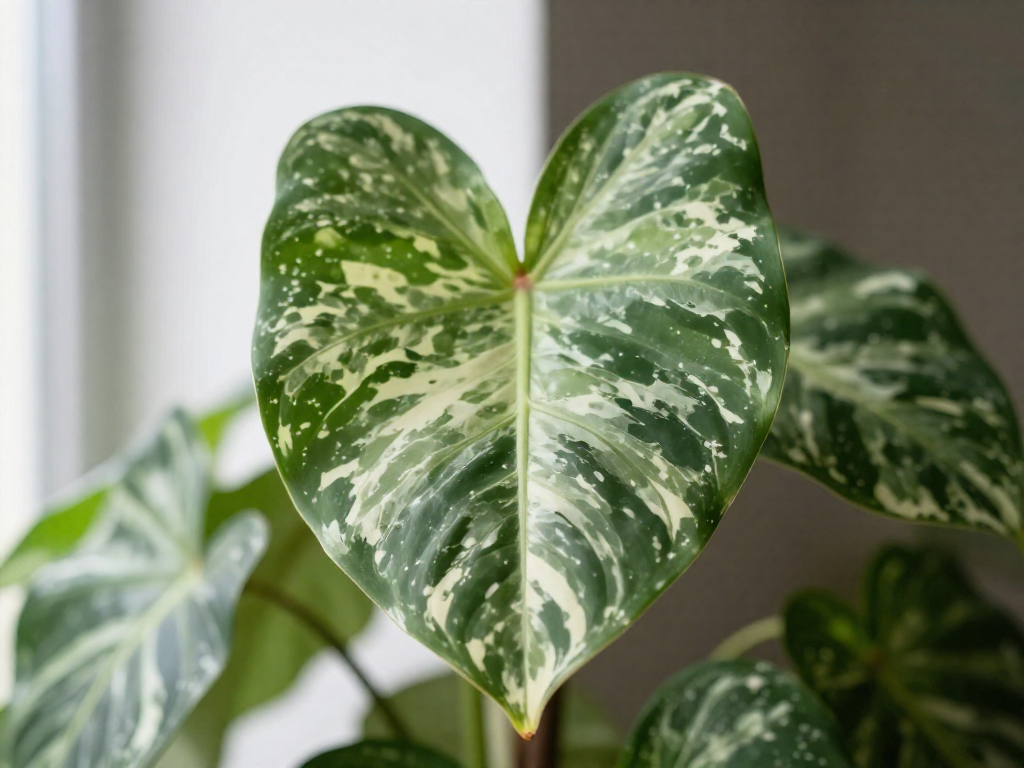
A Beginner's Glossary of Houseplant Terms
Confused by plant jargon? This plain-language glossary defines the houseplant terms beginners hit most—nodes, variegation, perlite, root-bound and more.
Jul 14, 2026 · 6 min read
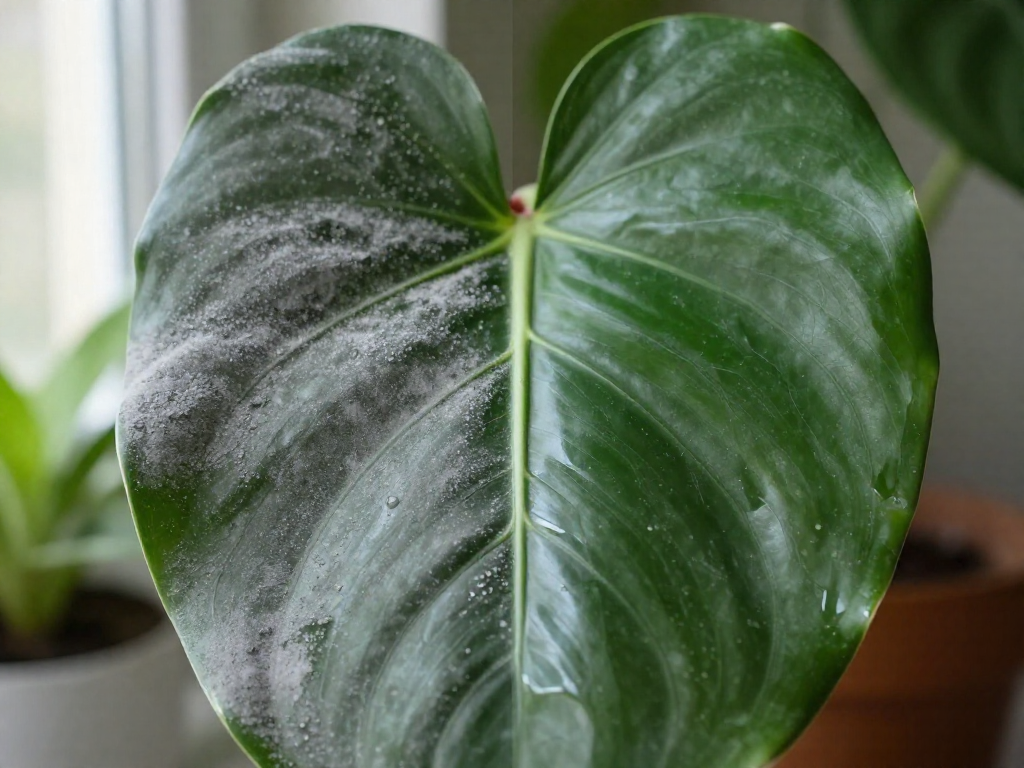
How to Clean Dusty Houseplant Leaves (and Why It Matters)
Dusty leaves block light and slow plant growth. Learn the simple, safe way to clean houseplant leaves by type—plus what to avoid, like leaf shine sprays.
Jul 14, 2026 · 6 min read
Winter Houseplant Care: Watering and Light When Days Get Short
Learn how to care for houseplants in winter: cut back watering, boost light and humidity, and pause feeding so your plants survive short, dark days.
Jul 14, 2026 · 11 min read