Reading the Light in Your Apartment: Bright, Medium, or Low
How much light does my window actually give?
On this page
Why You Can't Trust Your Eyes (and Why It Matters)
Here's the short answer to "how much light does my window actually give?": way less than you think—and your eyes are the reason you can't tell.
Your pupils adjust automatically as you move between rooms, so everything looks "bright enough." But that adaptation hides huge differences. A desk right by a window can be 10 times brighter than a spot across the hall that only looks "slightly darker" to you.
The real numbers make the gap obvious. Light intensity is measured in foot-candles (ftc)—one foot-candle is roughly the brightness of a single candle held one foot away. For scale:
- Outdoor sun at noon: peaks near 10,000 ftc (and can top 4,000 ftc even in winter)
- A north-facing window: may never reach 400 ftc
- A typical lit office or room: often 40 ftc or less
That's the trap: a room can feel perfectly bright to you and still deliver a tiny fraction of what a plant needs. Your eyes read "fine"; your plant reads "starving."
The bottom line: judge light where the leaves actually sit, not by how bright the room feels overall. A plant 12 inches from the glass and one 6 feet back are in completely different worlds, even at the same window. Get this right and most beginner plant problems solve themselves before they start.
Window Direction: Your First Clue
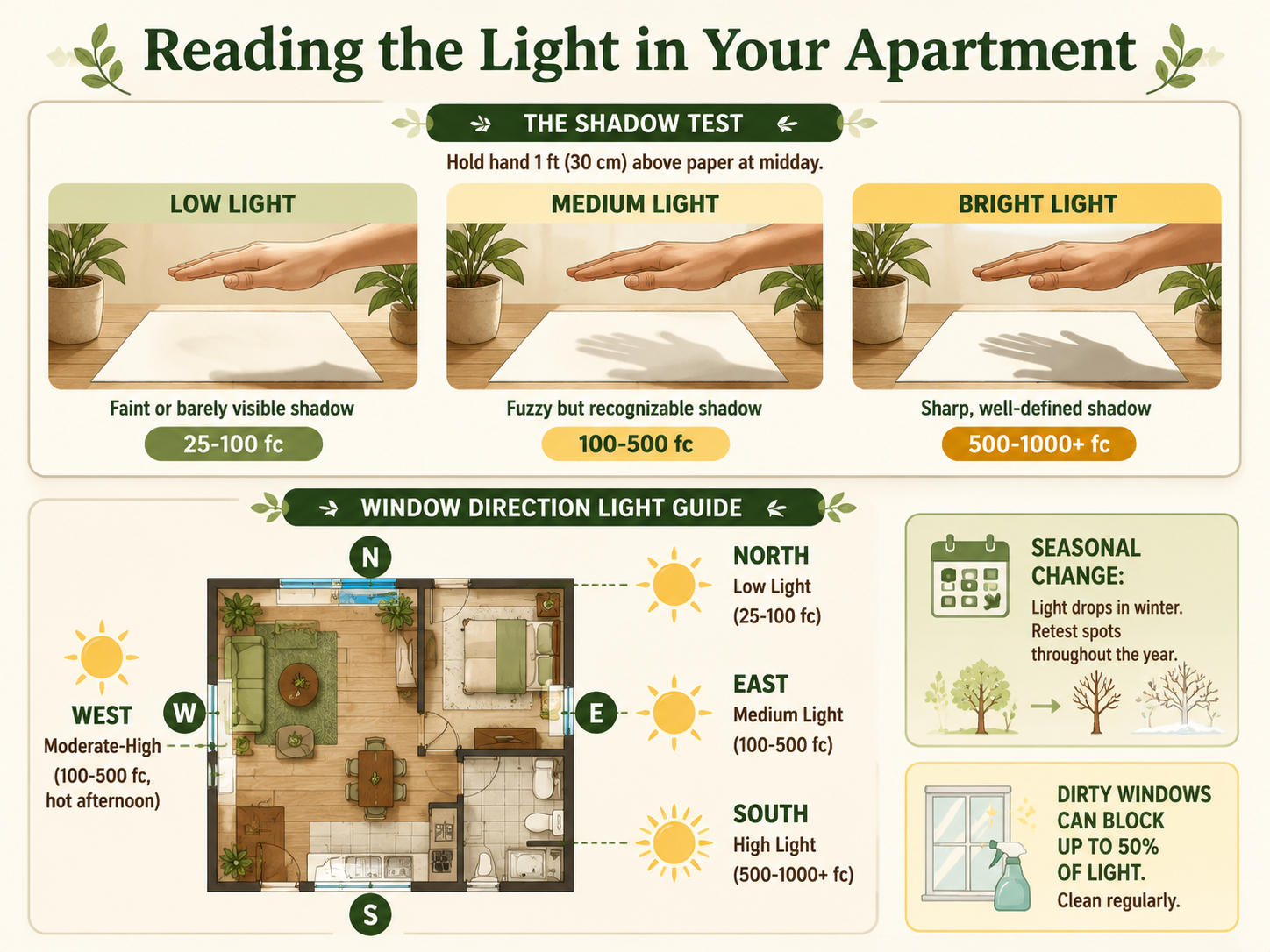
Before you buy a light meter or download an app, look at which way your windows face. In the northern hemisphere (that's all of the US), the compass direction of a window is the fastest way to estimate how much light it delivers.
Here's the memory-friendly version:
- South-facing = high light. Strong, direct sun for most of the day. This is your brightest exposure.
- North-facing = low light. Little to no direct sun—soft, dim, and steady. The weakest exposure.
- East-facing = moderate light. Gentle direct sun in the morning, softer for the rest of the day.
- West-facing = moderate-to-high light. Hot, intense direct sun in the afternoon.
Why east feels gentler than west, even though both get direct sun: it comes down to timing. East windows catch the morning sun before your walls, glass, and indoor air have heated up, so the light feels mild. West windows get their sun in the afternoon, after everything has already warmed—so the same amount of light lands with more heat and intensity.
If you like numbers, think in rough percentages. Using a south window as the benchmark for the strongest light, east and west windows deliver about 60% of that intensity, and north windows only about 20%. That's why north windows often aren't enough on their own for plants labeled "bright indirect light."
One important caveat: treat window direction as a starting estimate, not the final answer. A south window blocked by a neighboring building or balcony can be dimmer than an unobstructed east window, and a plant sitting 6 feet back from the glass gets far less light than one on the sill. We'll refine this estimate in the sections ahead—but direction is always your first clue.
The Shadow Test: Confirm It in 10 Seconds
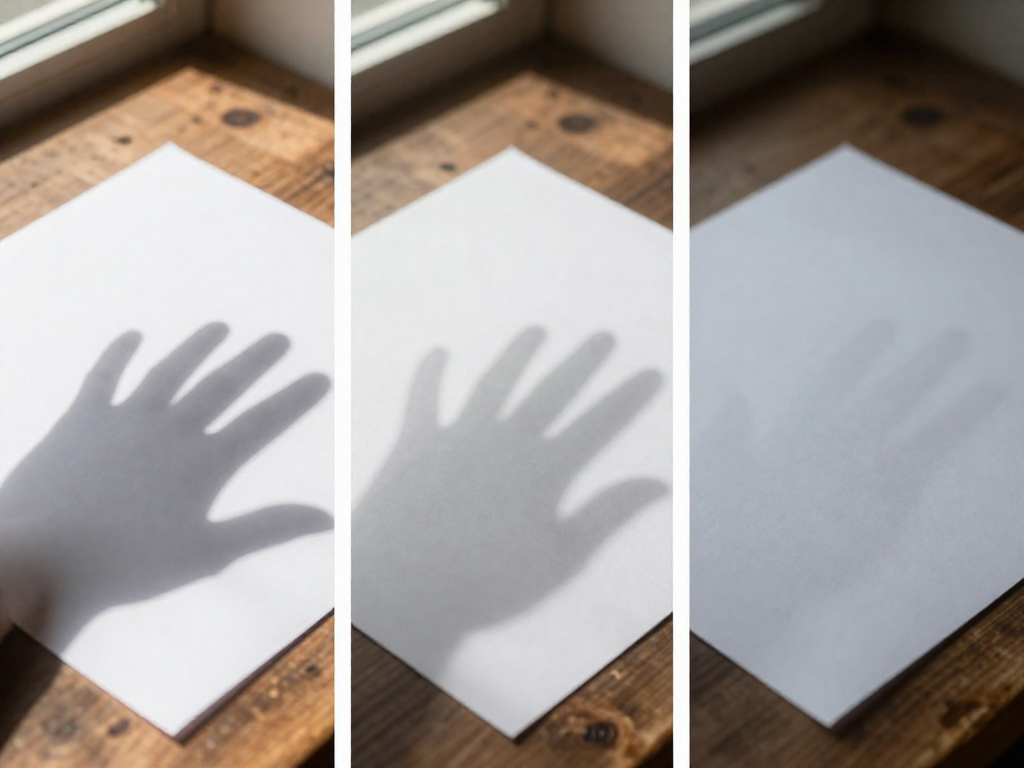
Window direction gives you a starting guess, but the fastest way to confirm a spot's light level takes ten seconds and zero equipment. It's called the shadow test, and it works because a shadow's crispness directly reflects how strong and direct the light is.
Here's the full-day version, recommended by horticulturist Justin Hancock of Costa Farms. Set an object in the spot you're curious about and watch the shadow it casts across the day:
- Sharp, well-defined shadow most of the day = bright light.
- Moderate, softer shadow with less definition = medium light.
- Little to no shadow = low light.
The 10-second midday version
Don't want to watch a shadow all day? Do this quick check instead. Place a sheet of white paper in the spot and hold your hand about a foot (30 cm) above it:
- Crisp, well-defined outline = bright.
- Clearly a hand but a bit fuzzy = medium.
- Faint and hard to make out = low.
That's it. You now have a reliable read on the exact spot.
Two rules for an accurate result
Test on a bright, uncloudy day. An overcast sky softens every shadow and will make a bright spot read as medium or low. You want a true reading, not a rainy-day one.
Check the exact spot where the leaves will sit—not the middle of the room. This is the whole point of the test: it measures reality, correcting for anything window direction alone can miss. A south window blocked by a neighboring building or balcony can be dimmer than an unobstructed east window, and light drops off fast as you move away from the glass. A plant 1 foot from the window and one 6 feet back are not in the same category, even at the same window.
One more thing worth remembering: light shifts with the seasons. A spot that reads medium in summer can fall to low in winter, so it's worth repeating this test a couple of times a year and moving plants if needed.
What Direction Alone Gets Wrong
Window direction is your starting point, not the final answer. In an apartment, four other variables can move a plant one or two full categories—so always judge light where the leaves actually sit, not by how bright the room feels.
Distance from the glass. Light drops off fast as you move inward. At a south window, direct sun reaches only about 2–3 feet, bright indirect light up to ~5 feet, and semi-shade out to ~8 feet (NYBG). A plant 1 foot from the glass and one 6 feet away are in completely different categories—even though it's the "same" window. North windows only offer semi-shade to about 5 feet.
Obstructions. A south window blocked by a balcony, awning, or a neighboring high-rise can be darker than an unobstructed east window. City renters especially lose light to tall buildings and narrow air shafts. Look outside: if a wall or roofline fills much of the view, discount the exposure.
Window size. A large picture window floods a room; a small bathroom window barely lights the sill. More glass means light reaches farther in.
Dirty glass. Grime can block up to 50% of incoming light (NYBG). Clean both sides—inside and out—especially if your windows haven't been washed in a while.
Quick check: name your exposure, then subtract for anything blocking the view, add or subtract for how close the plant sits, and account for grimy or undersized glass. That adjusted reading—not the compass alone—tells you whether a spot is bright, medium, or low.
Foot-Candle Ranges If You Want Numbers
If words like "medium light" feel too fuzzy, you can put numbers on it. Light indoors is often measured in foot-candles (ftc)—a unit for how much light lands on a surface. Horticulture sources (UF/IFAS, University of Maryland Extension, and others) agree on roughly these midday bands:
| Category | Foot-candles | Typical apartment spot |
|---|---|---|
| Low | 25–100 ftc | North window, or several feet from any window |
| Medium | 100–500 ftc | Near a window but out of direct sun |
| High | 500–1,000 ftc | Unshaded east/west window, or a shaded south window |
| Direct | 1,000+ ftc | Unshaded south window with 4+ hours of sun |
Keep two things in mind before you chase exact numbers.
These labels are guides, not science. "Low, medium, and high" are convenient generalizations, not precise botanical categories. Two sources can draw the line at slightly different numbers and both be reasonable. Use the bands to make a decision, not to split hairs.
Phone apps only get you in the ballpark. Free light-meter apps are handy, but they're rough. Android phones don't have standardized light-sensor hardware, and iPhones don't give apps access to the light sensor—so these apps estimate from camera brightness. UF/IFAS says plainly that apps "should only be used for approximations."
Measure at the exact spot the plant will sit. Small distance changes cause big light changes. A plant right against the glass and one two feet back are not in the same category, even at the same window. Take your reading where the leaves will actually be—then match it to the bands above.
Light Changes—Recheck With the Seasons
A light reading is only good for the day you take it. As the sun's angle drops through fall and winter, the same windowsill gets less intense light—so a spot that measured medium in July can fall to low by January. That shift is enough to tip a plant from thriving to struggling, even though nothing in the room moved.
Re-run the shadow test each season. Do it on a bright, uncloudy day around midday, and repeat it in spring, summer, fall, and winter. When a spot dims, be ready to relocate the plant closer to the window—or to a brighter one—rather than hoping it adjusts.
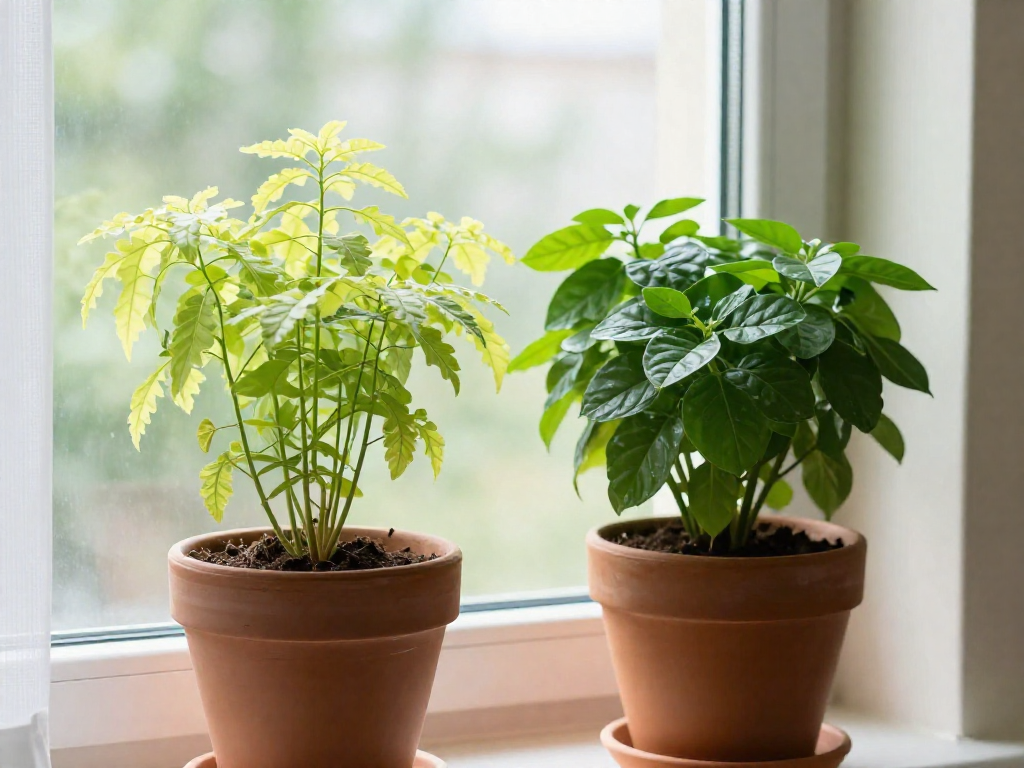
Watch for the signs of too little light. Your plants will tell you when a spot has gone dark. Look for:
- Leggy, spindly stretching—long, weak stems reaching for the window
- Leaning noticeably toward the light source
- Fading or pale color in the leaves
- Smaller new leaves than the older growth
- Lower leaves yellowing and dropping
- Variegation (the white or lighter patterns on leaves) turning solid green
Any of these means the spot no longer supplies enough light. Move the plant, then recheck it once the seasons turn again.
Match Your Spot to a Plant (Quick Guidance)
Once you know a spot's light level, use it to place the right plant there—or move a plant that isn't thriving.
Here's the catch with plant tags: most list the minimum light a plant needs to survive, not the light it actually wants. As horticulturist Justin Hancock puts it, "most plant tags refer to the minimum amount of light required for survival, so most plants that tolerate low light can grow in a brighter spot." In other words, a "low-light" plant usually looks better in medium light. So when in doubt, err brighter.
A few plants are pickier and need their light matched more carefully—orchids, for example, are sensitive and don't shrug off a wrong spot the way a pothos will.
Foot-candles (ftc)—a simple measure of how much light hits a surface—make this concrete. Say your mantle reads about 100 ftc at midday. That's fine for a ZZ plant, which tolerates the bare minimum. But a dracaena wants medium light, roughly 200 ftc or more, so on that same mantle it would slowly decline and need to move somewhere brighter.
The simple rule: if a plant looks leggy, pale, or is dropping lower leaves, shift it toward brighter light and check back in a couple of weeks. It's easier to dial a plant back than to nurse one starved of light.
Sources
- Check Light Levels For Houseplants With The Shadow Test | Gardening Know How — gardeningknowhow.com
- By Window Direction: North, South, East & West Playbooks — homeplantbot.com
- How to Choose the Right Light for your Indoor Plants — costafarms.com
- Window Orientation for Houseplants: N, E, S & W | Foliage Factory — foliage-factory.com
- Light for Houseplants – Gardening Solutions — gardeningsolutions.ifas.ufl.edu
- Lighting for Indoor Plants | University of Maryland Extension — extension.umd.edu
- Lighting | Houseplants | Illinois Extension | Illinois — extension.illinois.edu
- Home - Houseplant Basics - Research Guides at New York Botanical Garden — libguides.nybg.org
- Houseplant Light Guide for your indoor plants — thursd.com
- Bright Indirect Light “Requirements” by Plant Type — houseplantjournal.com
- What Type of Lighting Do I Have, Anyway? — howmanyplants.com
See also
- How Often Should You Water Your Houseplants?
- Best Low-Light Houseplants for Apartments
- Bright Indirect Light Explained
- Choosing the Right Potting Soil for Beginners
- Do You Need a Grow Light for Your Apartment?
Related articles
A Beginner's Glossary of Houseplant Terms
Confused by plant jargon? This plain-language glossary defines the houseplant terms beginners hit most—nodes, variegation, perlite, root-bound and more.
Jul 14, 2026 · 6 min read
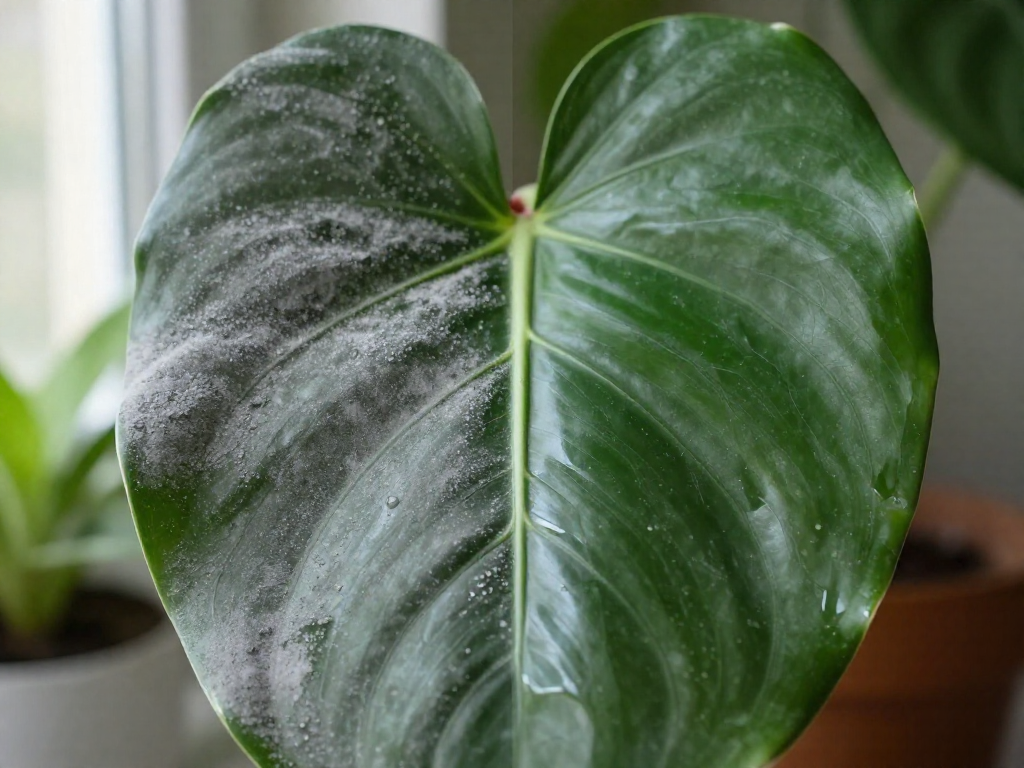
How to Clean Dusty Houseplant Leaves (and Why It Matters)
Dusty leaves block light and slow plant growth. Learn the simple, safe way to clean houseplant leaves by type—plus what to avoid, like leaf shine sprays.
Jul 14, 2026 · 6 min read
Winter Houseplant Care: Watering and Light When Days Get Short
Learn how to care for houseplants in winter: cut back watering, boost light and humidity, and pause feeding so your plants survive short, dark days.
Jul 14, 2026 · 11 min read